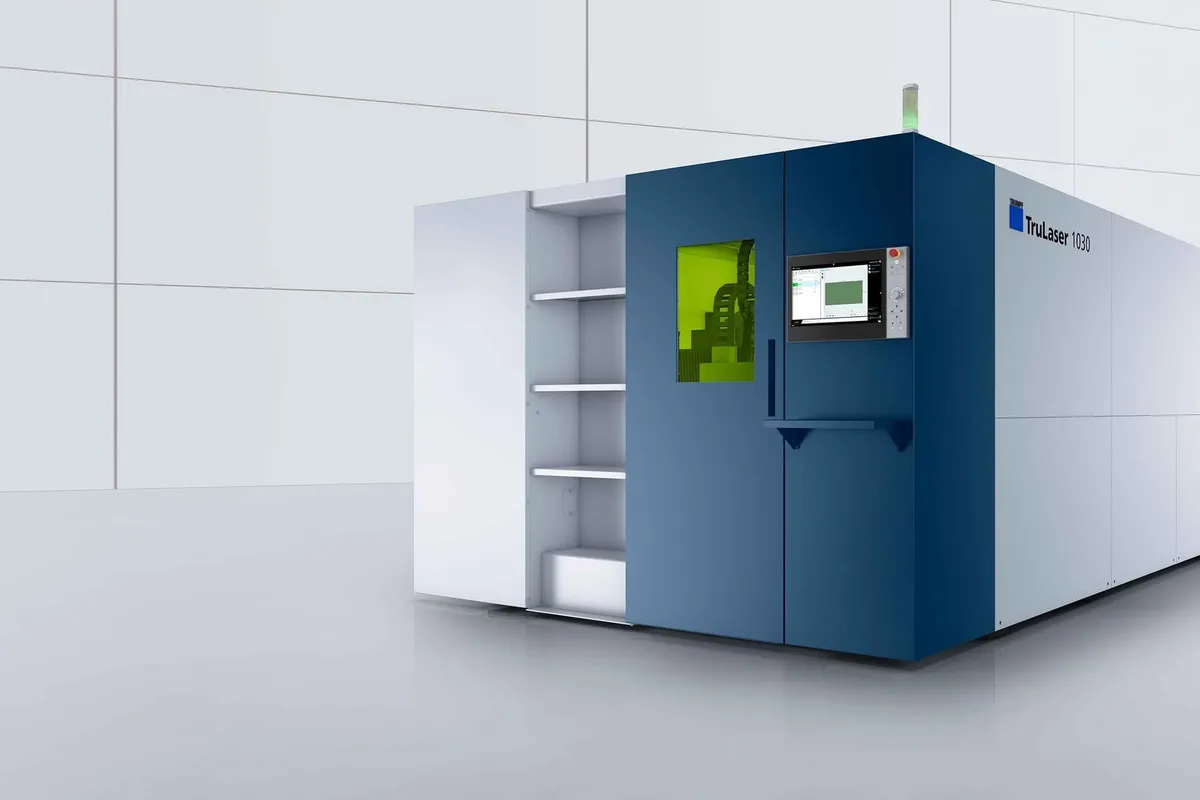
Trumpf TruLaser 1030 Fiber
Key Specifications
X Travel
Y Travel
max thickness copper 12kw
max thickness brass 12kw
max positioning speed
machine weight
How much does the Trumpf TruLaser 1030 Fiber cost?
Estimated price range
Our best estimate for a cnc laser cutting machine in this class — not a quote from Trumpf. Configuration moves it a long way.
Overview
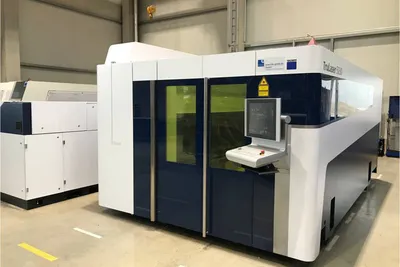
The Trumpf TruLaser 1030 Fiber is a flatbed fiber laser for 3,000 mm (118 in) by 1,500 mm (59.1 in) sheet, offered with four lasers from the TruFiber 4000 to the TruFiber 12001. It positions at up to 140 m/min, carries a workpiece of 900 kg (1,984 lb) and weighs 9,400 kg (20,723 lb).
The thickness rows show where extra laser power stops adding capacity. In mild steel the TruFiber 4000 cuts 22 mm (0.87 in), the TruFiber 6001 cuts 25 mm (0.98 in), and the TruFiber 9001 and TruFiber 12001 both cut 30 mm (1.18 in). Stainless steel follows the same pattern at 20 mm (0.79 in), 25 mm (0.98 in) and then 40 mm (1.57 in) for the two larger lasers. Copper and brass stop at 12.7 mm (0.50 in) from the TruFiber 9001 upward. In every listed material the TruFiber 12001 matches the TruFiber 9001 for maximum thickness, so the case for the largest laser has to rest on cutting speed, which the table does not quantify.
Set the workpiece limit beside those figures. A full-size steel sheet at the top thicknesses weighs more than 900 kg (1,984 lb), so the thickest plate has to be cut from smaller blanks. On thin and medium sheet the limit does not come into play.
The machine occupies 9,333 × 5,990 × 2,200 mm (367 × 236 × 86.6 in). Average power consumption is listed at 10 kW at the low end of the laser range and 16 kW at the top. The TruLaser 3030 Fiber works the same sheet size but weighs 11,700 kg (25,794 lb), positions at 170 m/min and carries 1,100 kg (2,425 lb).
Full Specifications
| Parameter | Value |
|---|---|
| Max Thickness Copper 12kw | 12.7 mm (0.50 in) |
| Max Thickness Brass 12kw | 12.7 mm (0.50 in) |
| Max Positioning Speed | 140 m/min |
| Machine Weight | 9,400 kg (20,723 lb) |
| Avg Power Consumption 4kw | 10 kW |
| Avg Power Consumption 12kw | 16 kW |
| X-Axis Travel | 3,000 mm (118 in) |
| Y-Axis Travel | 1,500 mm (59.1 in) |
| Max Workpiece Weight | 900 kg (1,984 lb) |
| Max Sheet Thickness Mild Steel | 22 / 25 / 30 / 30 mm (0.87 / 0.98 / 1.18 / 1.18 in) with TruFiber 4000 / 6001 / 9001 / 12001 |
| Max Sheet Thickness Stainless Steel | 20 / 25 / 40 / 40 mm (0.79 / 0.98 / 1.57 / 1.57 in) with TruFiber 4000 / 6001 / 9001 / 12001 |
| Max Sheet Thickness Aluminum | 20 / 25 / 30 / 30 mm (0.79 / 0.98 / 1.18 / 1.18 in) with TruFiber 4000 / 6001 / 9001 / 12001 |
| Max Sheet Thickness Copper | 8 / 10 / 12.7 / 12.7 mm (0.31 / 0.39 / 0.50 / 0.50 in) with TruFiber 4000 / 6001 / 9001 / 12001 |
| Max Sheet Thickness Brass | 8 / 10 / 12.7 / 12.7 mm (0.31 / 0.39 / 0.50 / 0.50 in) with TruFiber 4000 / 6001 / 9001 / 12001 |
| Floor Space Required | 9,333 × 5,990 × 2,200 mm (367 × 236 × 86.6 in) |
Specifications sourced from trumpf.com — verified 2026-10-03
Strengths & Limitations
Strengths
- Four laser choices, TruFiber 4000 / 6001 / 9001 / 12001
- Stainless steel up to 40 mm (1.57 in) and mild steel up to 30 mm (1.18 in) with the TruFiber 9001
- Copper and brass up to 12.7 mm (0.50 in) with the two larger lasers
- At 9,400 kg (20,723 lb) it is lighter than the TruLaser 3030 Fiber, which weighs 11,700 kg (25,794 lb) for the same sheet size
- Average power consumption of 10 kW at the low end of the laser range
Limitations
- Maximum workpiece weight is 900 kg (1,984 lb), less than a full steel sheet at the top thicknesses
- The TruFiber 12001 adds no listed thickness over the TruFiber 9001 in any material
- Positioning speed is 140 m/min, against 170 m/min on the TruLaser 3030 Fiber
- The TruFiber 4000 is limited to 8 mm (0.31 in) in copper and brass
Best For
Frequently Asked Questions
01
Four: TruFiber 4000 / 6001 / 9001 / 12001. Listed mild steel thickness is 22 mm (0.87 in), 25 mm (0.98 in), 30 mm (1.18 in) and 30 mm (1.18 in) in that order, so the two largest lasers share the same maximum.
02
Stainless steel is listed at 20 / 25 / 40 / 40 mm (0.79 / 0.98 / 1.57 / 1.57 in) and aluminum at 20 / 25 / 30 / 30 mm (0.79 / 0.98 / 1.18 / 1.18 in), in the order TruFiber 4000 / 6001 / 9001 / 12001.
03
Yes. Both are listed at 8 mm (0.31 in) with the TruFiber 4000, 10 mm (0.39 in) with the TruFiber 6001, and 12.7 mm (0.50 in) with the TruFiber 9001 and the TruFiber 12001.
04
Both work 3,000 mm (118 in) by 1,500 mm (59.1 in). The TruLaser 1030 Fiber weighs 9,400 kg (20,723 lb), positions at 140 m/min and carries 900 kg (1,984 lb), while the TruLaser 3030 Fiber weighs 11,700 kg (25,794 lb), positions at 170 m/min and carries 1,100 kg (2,425 lb).
05
The footprint is 9,333 × 5,990 × 2,200 mm (367 × 236 × 86.6 in) and the machine weighs 9,400 kg (20,723 lb). Average power consumption is listed at 10 kW for the smallest laser row and 16 kW for the largest.
Videos

TRUMPFtube

TRUMPFtube

Mid Atlantic Machinery Group

PT. ISOTEMA
Community Discussions
Comparisons
More from Trumpf
Other CNC Laser Cutting Machines
Dener Pro DC 3015
Cincinnati CL-900 2m x 4m
LVD LaserTWO 3015
Bystronic BySprint Pro
Penta Laser NLF 12050V