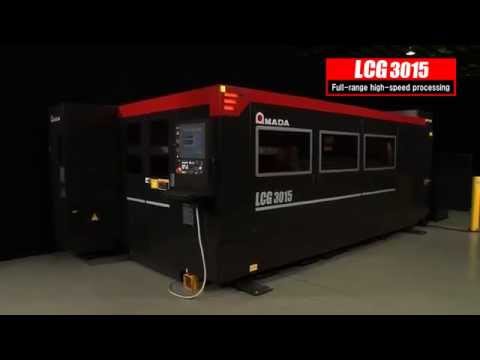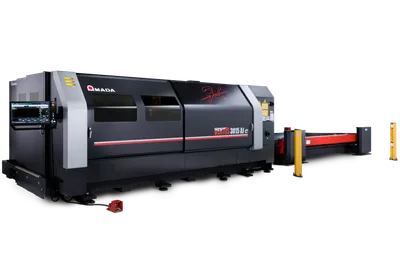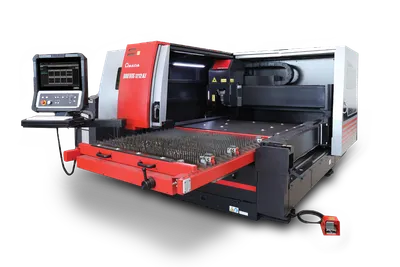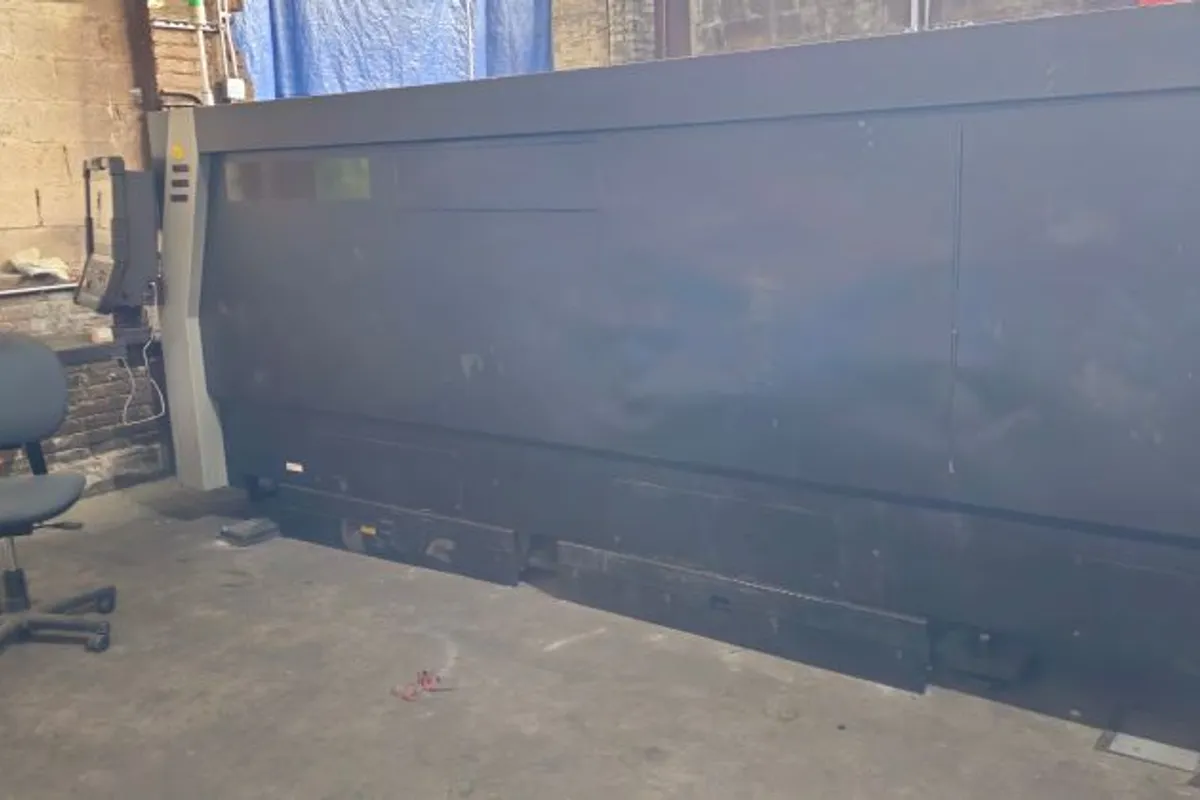
Amada LCG-3015AJ
Key Specifications
Repeatability
working area
z axis travel
laser type
laser power options
max thickness mild steel 3kw
Overview
The Amada LCG-3015AJ is Amada's flagship fiber laser cutting system, built around their proprietary AJ (Amada Journal) fiber engine. It's a flying-optics machine with a 3,070 x 1,550 mm (121 x 61 in) working area -- the standard 5x10 ft sheet size that covers the vast majority of North American and European fabrication work. The sheet stays stationary while the cutting head moves across all three axes, which means you're not accelerating heavy material and you get better accuracy at speed.
Amada offers the LCG-3015AJ in five power configurations: 2 kW, 3 kW, 4 kW, 6 kW, and 9 kW. The 3 kW version -- the most common in the field -- cuts up to 18 mm (0.71 in) mild steel, 15 mm (0.59 in) stainless, 12 mm (0.47 in) aluminum, 8 mm (0.31 in) brass, and 6 mm (0.24 in) copper with oxygen or nitrogen assist gas. Higher-wattage models push those numbers further and dramatically increase cutting speed on thin stock. The 9 kW variant, introduced in 2017, handles 25 mm mild steel and tears through thin gauge material at speeds that make CO2 lasers look like they're standing still.
The drive system uses AC servo motors with a helical rack-and-pinion arrangement, delivering rapid traverse speeds of 120 m/min (4,724 ipm) on both X and Y axes and 80 m/min (3,150 ipm) on Z. Repeatability is +/- 0.005 mm (0.0002 in), which is tight enough for precision sheet metal work without secondary operations. The low center-of-gravity carriage design keeps vibration down at high acceleration rates, so you can actually use those rapid speeds without sacrificing cut quality.
Amada designed the AJ fiber engine in-house rather than sourcing from IPG or nLIGHT like most competitors. The single-module resonator (no beam combiner on the 3 kW) delivers a higher beam density that translates to faster piercing and cleaner cuts, especially on reflective metals like copper and brass that gave CO2 lasers fits. Energy consumption runs roughly one-third of an equivalent CO2 setup -- the fiber resonator converts electrical energy to laser light at about 30% efficiency vs 10% for CO2.
The machine runs on Amada's AMNC 3i control with a touchscreen LCD display. It handles X, Y, Z simultaneous interpolation plus focus lens position (B-axis) and laser power modulation. Programming happens through Amada's AP100 CAM software, which handles nesting, toolpath generation, and cutting condition databases. The control stores material-specific cutting parameters, so operators can switch between jobs without manually dialing in feed rates and power settings.
Table loading capacity is 920 kg (2,028 lb), and the machine itself weighs 9,100 kg (20,062 lb) with overall dimensions of 10,136 x 2,840 x 2,432 mm (399 x 112 x 96 in). Power requirements are 200V/60Hz three-phase (+/- 10%). Amada offers several automation options including the ASFH compact load/unload system and multi-shelf tower storage for lights-out production.
New LCG-3015AJ machines with a 3-4 kW laser list around $450,000-$600,000 depending on configuration and automation. Used machines from 2014-2018 trade in the $100,000-$250,000 range depending on laser hours, power level, and included automation. A 2015 model with 4 kW laser and ASFH tower has been listed around $199,500. Direct competitors include the Trumpf TruLaser 3030/3040, Bystronic ByStar Fiber, and Mazak Optiplex 3015 NEO. Amada's edge is the in-house fiber engine with its higher beam density and the integrated automation ecosystem.
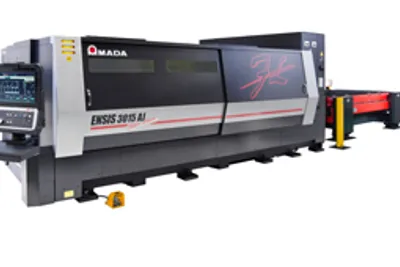
Note: Amada has since introduced the ENSIS series as the successor to the LCG-AJ line, featuring variable beam control technology. The LCG-3015AJ remains widely available on the used market and is still supported by Amada's service network. Specs sourced from Amada EU published technical data, Amada Japan product pages, and verified dealer listings.
Full Specifications
| Parameter | Value |
|---|---|
| Working Area | 3,070 x 1,550 mm (121 x 61 in) |
| Z Axis Travel | 100 mm (3.93 in) |
| Laser Type | AJ fiber (LD-excited Yb fiber, 1.08 micron wavelength) |
| Laser Power Options | 2 kW / 3 kW / 4 kW / 6 kW / 9 kW |
| Max Thickness Mild Steel 3kw | 18 mm (0.71 in) |
| Max Thickness Stainless Steel 3kw | 15 mm (0.59 in) |
| Max Thickness Aluminum 3kw | 12 mm (0.47 in) |
| Max Thickness Brass 3kw | 8 mm (0.31 in) |
| Max Thickness Copper 3kw | 6 mm (0.24 in) |
| Rapid Traverse Xy | 120 m/min (4,724 ipm) |
| Rapid Traverse Z | 80 m/min (3,150 ipm) |
| Repeatability | +/- 0.005 mm (0.0002 in) |
| Table Load Capacity | 920 kg (2,028 lb) |
| Machine Weight | 9,100 kg (20,062 lb) |
| Machine Dimensions | 10,136 x 2,840 x 2,432 mm (399 x 112 x 96 in) |
| CNC Control | AMNC 3i (touchscreen LCD) |
| Drive System | AC servo motors, helical rack-and-pinion |
| Power Supply | 200V / 60Hz, 3-phase (+/- 10%) |
| Lcg 3015aj | 120:120:80 |
| Feature High Speed Processing Of Thin To Medium Materials | A lightweighted carriage is adopted (30% less mass as compared with Amada's conventional laser machines). |
| Feature The Fiber Laser Provides Lost Cost Cutting | The low center of gravity carriage allows for high-speed processing of thin materials. |
Specifications sourced from amada.co.jp — verified 2026-03-28
Strengths & Limitations
Strengths
- Amada's in-house AJ fiber engine delivers higher beam density than third-party resonators, resulting in faster piercing and cleaner cuts on reflective metals like copper and brass
- Flying-optics design keeps the sheet stationary -- you get better accuracy at high speed since you're not accelerating 920 kg of material
- Five laser power options from 2 kW to 9 kW let you match the machine to your actual material mix without overpaying for capacity you don't need
- 120 m/min rapid traverse on X/Y keeps non-cutting time low on nested sheets, and the low center-of-gravity carriage maintains cut quality at high acceleration
- Energy consumption runs roughly one-third of an equivalent CO2 laser -- the fiber resonator's 30% wall-plug efficiency compounds into real savings over thousands of cutting hours
- AMNC 3i control with stored cutting condition databases means operators can switch materials and thicknesses without manual parameter entry
- Automation ecosystem (ASFH load/unload, tower storage) integrates for lights-out production on standard 5x10 ft sheets
Limitations
- Amada parts and service can be expensive and slow, especially outside major metro areas -- multiple owners report frustration with Amada's responsiveness on legacy LCG models
- The LCG-AJ line has been superseded by the ENSIS series with variable beam control -- new units are no longer available, limiting you to the used market
- AP100 CAM software locks you into Amada's ecosystem; third-party CAM integration is limited compared to Trumpf's TruTops or Bystronic's BySoft
- 920 kg table load capacity is lower than some competitors -- heavy plate work may require manual assistance or upgraded pallets
- 3 kW base model tops out at 18 mm mild steel; if you regularly process thicker plate, you'll need the 6 kW or 9 kW variant, which commands a significant price premium
Best For
Frequently Asked Questions
01
New machines listed around $450,000-$600,000 depending on laser power and automation options. Used machines from 2014-2018 trade for $100,000-$250,000 depending on laser hours, wattage, and included equipment. A 2015 model with 4 kW laser and ASFH tower automation has been listed at $199,500. Add $50,000-$150,000 for tower storage and automated load/unload systems.
02
The ENSIS series replaced the LCG-AJ line and features Amada's variable beam control technology, which automatically adjusts the beam diameter based on material type and thickness. The LCG-AJ uses a fixed beam profile. In practice, the ENSIS handles a wider range of thicknesses with a single lens, while the LCG-AJ ships with two cutting lenses (5-inch for thin stock, 7.5-inch for thicker material). The ENSIS also comes in higher power options up to 12 kW and 15 kW.
03
Yes -- this is one of fiber laser's key advantages over CO2. The 1.08-micron wavelength absorbs into reflective metals instead of bouncing back into the optics. The 3 kW model cuts up to 6 mm copper and 8 mm brass. Higher-wattage variants push those limits further. Nitrogen assist gas gives you oxide-free edges on brass and copper.
04
Amada has a solid service network in major markets, but owners of older LCG models report mixed experiences. Response times can be slow outside major metro areas, and parts pricing is premium. Some shops have had success with third-party parts suppliers like altparts.com for consumables and wear items. If you're buying used, factor in service contract costs -- they typically run $10,000-$20,000 per year.
05
Amada offers the ASFH 3015G compact load/unload system with multi-shelf tower storage, dual shuttle tables for continuous processing, and integration with Amada's MP series material handling. The ASFH tower can store multiple sheets and finished parts, enabling lights-out or lightly attended production. Most production shops pair the LCG-AJ with at least dual shuttle tables to keep cutting while loading the next sheet.
06
Nitrogen for clean, oxide-free cuts on stainless steel, aluminum, brass, and copper. Oxygen for mild steel -- it creates an exothermic reaction that increases cutting speed and allows thicker material processing. Compressed air can be used as a low-cost alternative for non-critical cuts. The machine's ECO Cut mode optimizes oxygen-assisted cutting for lower gas consumption on mild steel.
Videos
John Taylor Engineering Services Ltd
AMADA AMERICA, INC.
PrestigeEquipment
CNCMedia
Amada UK LTD
Community Discussions
Troubleshooting and problem-solving — Fabrication: CNC Laser, Waterjet, Plasma, Welding | Amada ...
Pricing and buying discussion — URGENT Need part for Amada LCG3015AJ head. - Practical Machinist
Community discussion — Fabrication: CNC Laser, Waterjet, Plasma, Welding | Amada 2k ...
Capabilities and material handling — Hello all, trying to cut 1" Mild steel on Amada Ensis 3015 AJ ...
Links to community discussions. Summaries are editorial — visit the original thread for full context.


![Amada - LCG 3015 AJ fiber laser [ENG]](https://i.ytimg.com/vi/MK0YwAswpEY/hqdefault.jpg)