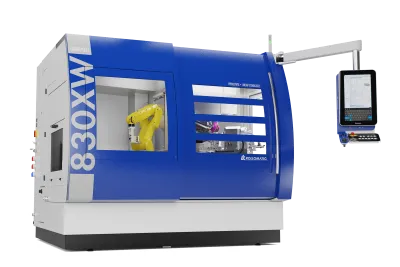
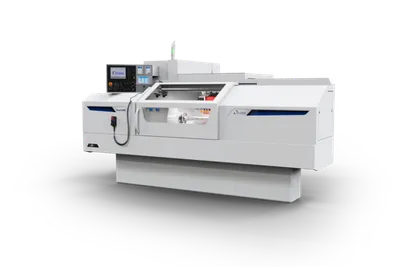
Sunnen SV-620
Key Specifications
bore diameter range
max workpiece height
max workpiece weight
stroke length
spindle speed range
stroke rate
Overview
The Sunnen SV-620 is a large-bore CNC vertical honing machine from Sunnen Products Company of St. Louis, Missouri — the global leader in honing technology since 1924. The SV-620 extends Sunnen's vertical honing capability to large bores, targeting connecting rod big-end and small-end bore honing, diesel engine cylinder liner honing, large hydraulic cylinder bores, and industrial applications involving bores from 50 mm to 450 mm in diameter.
Vertical honing machines use the weight of the honing spindle assembly to assist consistent stone pressure and eliminate the bore distortion that can occur in horizontal honing when the workpiece sags under its own weight. For deep bores (length-to-diameter ratios greater than 3:1) and large-diameter bores (> 100 mm), the vertical configuration provides superior bore geometry control — roundness, cylindricity, and taper — compared to horizontal alternatives. The SV-620's heavy-duty spindle and stroke mechanism accommodate workpieces up to 1,200 mm tall and 1,500 kg in weight, handling truck engine cylinder blocks, large hydraulic cylinder bodies, and heavy diesel connecting rods.
Sunnen's active in-process gauging (PBG — Precision Bore Gauging) is standard on the SV-620, continuously measuring bore diameter during honing and automatically controlling stone expansion to approach the target diameter with the correct finishing behavior. The SV-620's CNC provides multi-step honing programs — roughing, sizing, and finishing passes with automatic abrasive changeover prompts — enabling fully programmatic bore finishing from raw bored-to-size to final honed dimension without manual intervention between steps.
At $300,000–$500,000, the SV-620 is the production standard for large-bore engine and hydraulic cylinder honing operations. Sunnen's global tooling supply chain — honing stones, mandrels, and accessories — provides the process consumables infrastructure that production honing operations depend on.
Full Specifications
| Parameter | Value |
|---|---|
| Bore Diameter Range | 50 - 450 mm (2 - 17.7 in) |
| Max Workpiece Height | 1,200 mm (47.2 in) |
| Max Workpiece Weight | 1,500 kg (3,307 lb) |
| Stroke Length | Up to 900 mm (35.4 in) |
| Spindle Speed Range | 30 - 400 RPM |
| Stroke Rate | Up to 40 strokes/min |
| Surface Finish Achievable | Ra 0.1 - 1.6 µm (plateau hone profile standard) |
| Bore Roundness | < 0.002 mm |
| In Process Gauging | Sunnen PBG active gauging (standard) |
| CNC Control | Sunnen SG5 CNC with multi-step honing programs |
| Machine Weight | ~5,500 kg (12,125 lb) |
| Coolant | Honing oil or water-soluble coolant, integrated filtration |
Specifications sourced from sunnen.com — verified 2026-03-28
Strengths & Limitations
Strengths
- 450 mm maximum bore diameter covers diesel engine cylinder bores, large connecting rod big-end bores, and hydraulic cylinder bores up to 18 inches in a single machine platform
- Vertical configuration eliminates workpiece sag and provides superior bore geometry control (roundness, cylindricity) for long, large-diameter bores versus horizontal honing
- Sunnen PBG active gauging automatically controls stone expansion and stops at target bore size — consistent bore diameter regardless of operator skill level
- 1,500 kg workpiece capacity handles heavy cylinder blocks, large connecting rods, and thick-walled hydraulic cylinder bodies without requiring separate fixturing solutions
- Multi-step CNC honing programs transition automatically from rough honing to finish honing to plateau honing without operator intervention between abrasive steps
Limitations
- 1,200 mm maximum workpiece height limits the SV-620 to bores shorter than 1,200 mm — longer hydraulic cylinders require horizontal honing machines
- Large tooling (mandrels, stone holders) for 100–450 mm bores is heavy and requires careful handling during tool changes — consider tool changers or dedicated tooling carts
- Honing generates significant volumes of abrasive-laden coolant requiring robust filtration and scheduled maintenance — operational cost factor in large-bore honing
Best For
Frequently Asked Questions
01
The SV-310 handles bore diameters of 25–200 mm and workpieces up to 500 mm tall — covering passenger car engine cylinders, transmission bores, and medium hydraulic cylinders. The SV-620 extends the diameter range to 50–450 mm and workpiece height to 1,200 mm, targeting heavy-duty diesel engine cylinder bores, large connecting rod big-end bores, and large-diameter hydraulic cylinders. The SV-620 has a heavier spindle drive, longer stroke mechanism, and higher workpiece weight capacity (1,500 kg vs. the SV-310's lighter capacity). For shops that need both ranges, the SV-620's lower end (50–200 mm) overlaps with the SV-310, but the SV-310 provides more economical coverage for the smaller bore range.
02
Diesel engine cylinder bores in cast iron blocks typically use silicon carbide (SiC) honing stones for roughing (80–120 grit) followed by aluminum oxide (Al2O3) or SiC for sizing (220–320 grit) and plateau honing (400–600 grit). The final plateau honing step produces the desired crosshatch angle (typically 45–60 degrees to the bore axis) with flat plateaus (Rp < 0.2 µm) and oil-retaining valleys (Rvk 0.5–1.5 µm) for piston ring seating. Sunnen supplies the complete stone specification for each application — block material, bore diameter, target surface texture parameters — from its application database covering thousands of engine families.
03
Connecting rod big-end bore honing typically follows a bore-resizing operation (grinding the cap and rod mating surfaces then reassembling to bore the round big-end hole). The honed bore receives a press-fit or slip-fit bearing shell and must meet tight roundness (< 0.005 mm), cylindricity, and surface finish (Ra 0.4–0.8 µm crosshatch) specifications. On the SV-620, connecting rods are fixtured vertically in a work-holding plate that allows the rod to be presented to the honing spindle at the correct angle. Small-end bores (for pin bushings) are honed in the same setup after a fixture change — the small-end bore typically targets Ra 0.4–0.8 µm and close dimensional tolerance for interference fit with the pin bushing.
04
Plateau honing is a two-step surface finish process: first, a relatively coarse honing step (80–220 grit) produces the crosshatch pattern and corrects bore geometry; second, a short plateau honing step (400–600 grit, minimum strokes) removes the surface peaks (the 'peaks' of the Ra profile) without removing the valleys. The result is a Rk surface profile with a flat plateau (Rk 0.3–0.6 µm), shallow oil-retaining valleys (Rvk 0.5–1.5 µm), and minimal peaks (Rpk < 0.1 µm). This surface supports the piston rings during break-in (rings wear against the flat plateaus until fully seated) while the valleys store oil at the ring interface. Diesel engines without plateau honing take longer to break in and may consume more oil during the break-in period.
05
Yes. Hydraulic cylinder bores require Ra 0.2–0.8 µm crosshatch surface finish for dynamic piston seal compatibility — smoother than that and the seal may not receive adequate lubrication from the hydraulic fluid; rougher and the seal wears rapidly. The SV-620 produces Ra 0.1–1.6 µm across the full bore diameter range, covering the hydraulic cylinder specification. Bore roundness (< 0.002 mm) and cylindricity (taper < 0.005 mm over bore length) are critical for seal performance — out-of-round bores cause piston seal breathing (seal edge loading varies by rotation angle), leading to seal wear and cylinder leakage. The SV-620's vertical configuration and active gauging provide the geometry control required for hydraulic cylinder bore finishing.
Videos

dee dee

DBCBob

Александр Овчинников

Whiplash Engines and Machine
Community Discussions
Community discussion — Help with Sunnen bore gage or setting fixture parts
Comparison and buying advice — Rottler vs Sunnen Hone - Practical Machinist
Community discussion — Sunnen dial bore gage | Page 2 - Practical Machinist
Community discussion — Clean & Refurb of Small Sunnen Hone - Practical Machinist
Maintenance and service — Sunnen is garbage now : r/Machinists - Reddit
Community discussion — Anyone know how to clear This? : r/Machinists - Reddit
Community discussion — benchtop lathe/mill recommendations? : r/Machinists - Reddit
Pricing and buying discussion — Quiet air compressor recommendations? : r/Machinists - Reddit
Links to community discussions. Summaries are editorial — visit the original thread for full context.