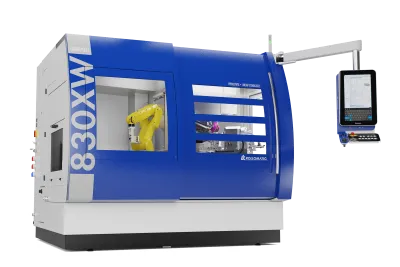
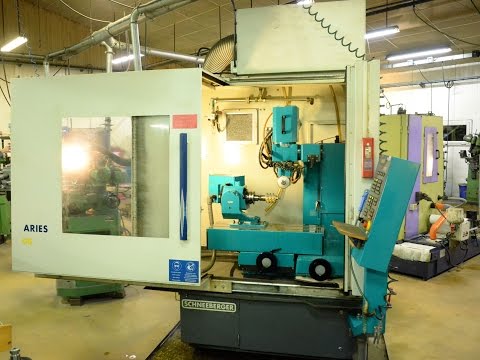
Schneeberger ARIES
This model was not found in Schneeberger's current lineup when we checked on 2026-10-03 . It may be a superseded or older model; the specifications below are as we last recorded them.
Key Specifications
Max Workpiece ⌀
grinding application
max workpiece length
center height
thread grinding range
pitch range
How much does the Schneeberger ARIES cost?
Estimated price range
Our best estimate for a cnc grinding machine in this class — not a quote from Schneeberger. Configuration moves it a long way.
Overview
The Schneeberger ARIES is described by the listed figures as a thread and precision form grinding machine taking work up to 1,000 mm (39.4 in) between centers, with a center height of 150 - 200 mm depending on configuration. It is not in Schneeberger's current lineup. The Aries NGP is a separate model with its own table, 420 mm, 360 mm and 260 mm of travel and an HSK 50 spindle, and its figures do not apply here.
The thread range is given as M1 to M200, external and internal, with pitches from 0.1 to 100 mm; both are marked application-dependent. Maximum workpiece diameter follows from the center height and is given as typically up to 350 mm. Single-profile, multi-rib and form wheels are all listed as supported, which would let the same machine plunge a short thread with a multi-rib wheel or traverse a long screw with a single profile.
Lead is synchronised by an electronic gearbox on a Siemens 840D sl control with thread grinding cycles, driving a C-axis workhead. The listed figures state lead accuracy only as sub-arc-second synchronization, with no pitch error over length, and that is the number a thread grinding shop needs. Anyone assessing a machine under this name should ask for a measured lead chart on a test piece near their own length, and should establish the center height and whether the base is polymer concrete or cast iron, since both vary by configuration.
Full Specifications
| Parameter | Value |
|---|---|
| Grinding Application | Thread grinding and precision form grinding |
| Max Workpiece Length | Up to 1,000 mm (39.4 in) between centers |
| Center Height | 150 - 200 mm (configuration-dependent) |
| Max Workpiece Diameter | Depends on center height; typically up to 350 mm |
| Thread Grinding Range | External and internal threads, M1 to M200 range (application-dependent) |
| Pitch Range | 0.1 to 100 mm pitch (application-dependent) |
| Lead Accuracy | Sub-arc-second lead synchronization (electronic gearbox) |
| Grinding Wheel Configuration | Single-profile, multi-rib, and form wheel support |
| CNC Control | Siemens 840D sl with electronic gearbox and thread grinding cycles |
| Workhead | High-precision C-axis synchronized workhead |
| Machine Base | Polymer concrete or cast iron (configuration-dependent) |
| Coolant | High-pressure flood coolant with fine filtration |
Specifications compiled from manufacturer literature and industry references. Not independently verified against a published spec sheet — confirm with the manufacturer or an authorised dealer before making a purchasing decision.
Strengths & Limitations
Strengths
- Listed thread range of M1 to M200, covering external and internal threads (application-dependent)
- Takes work up to 1,000 mm (39.4 in) between centers
- Pitch range listed as 0.1 to 100 mm (application-dependent)
- Single-profile, multi-rib and form wheels are all listed as supported
Limitations
- Lead accuracy is stated only as sub-arc-second synchronization; the listed figures give no pitch or lead error over length
- Center height (150 - 200 mm) and base material both depend on configuration, so two machines can differ
- Maximum workpiece diameter is given only as typically up to 350 mm and depends on the center height
Best For
Frequently Asked Questions
01
The listed figures give up to 1,000 mm (39.4 in) between centers and a center height of 150 - 200 mm, depending on configuration. Maximum workpiece diameter depends on that center height and is given as typically up to 350 mm.
02
External and internal threads in the M1 to M200 range, with pitches from 0.1 to 100 mm. Both ranges are marked application-dependent, so the wheel, the workholding and the thread form of a particular job decide what is reachable in practice.
03
A Siemens 840D sl with an electronic gearbox and thread grinding cycles. The gearbox synchronises the C-axis workhead with the traverse; the listed figures describe the result as sub-arc-second lead synchronization and give no lead error figure.
04
The configuration. Center height is listed as 150 - 200 mm and the base as polymer concrete or cast iron, both configuration-dependent. Ask for a measured lead chart as well, because the listed figures contain no pitch error value, and confirm the coolant system, described only as high-pressure flood with fine filtration.
Videos
RDMO Second-Hand Machine Tools

GNS Maquinas
More from Schneeberger
Other CNC Grinding Machines
Supertec G20A-30CNC
Voumard 1000
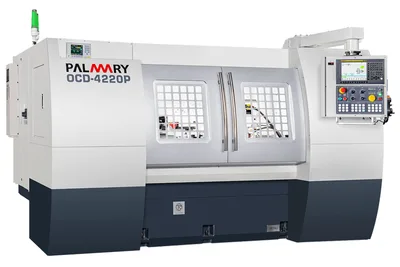
Palmary OCD-4280P
Studer S151

Hardinge Kellenberger T1000