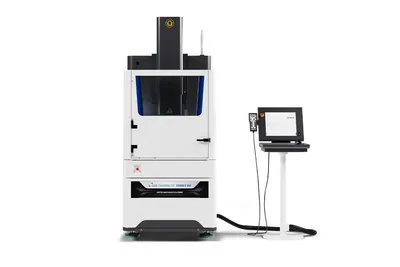
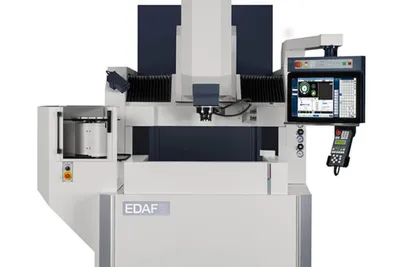
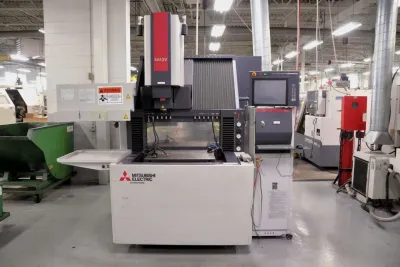
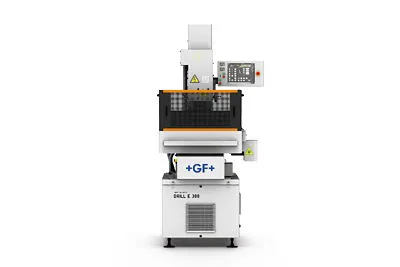
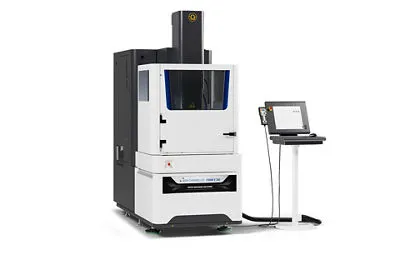
ONA Electroerosion TF300
Key Specifications
X / Y Travel
Z-Axis Stroke
Electrode Diameter Range
Electrode Type
Max Drilling Depth
Drilling Speed (Steel, 1 mm electrode)
Overview
The ONA Electroerosion TF300 is a dedicated EDM hole drilling machine, also known as a fast hole drill EDM or EDM drill, designed to produce precision start holes in hardened steel, carbide, and other difficult-to-machine materials. These start holes are required before wire EDM can thread through a workpiece, making the TF300 an essential companion machine in wire EDM departments that process through-hardened tooling and exotic alloys where conventional drilling is impractical.
The TF300 uses rotating tubular electrodes — typically brass or copper tubes ranging from 0.3 mm to 3.0 mm in diameter — through which dielectric fluid is pumped under pressure to flush debris from the hole as it is drilled by electrical discharge. This process enables hole drilling in materials of any hardness at rates substantially faster than EDM sinking with solid electrodes, and produces holes with excellent cylindricity even in steels above 60 HRC.
ONA's design for the TF300 emphasizes automatic depth control, electrode compensation for wear, and programmable multi-hole sequences on a single workpiece fixture. The machine's Z-axis servo provides precise depth control with automatic retract-on-breakthrough detection, which stops drilling as soon as the electrode exits the back face of the workpiece to prevent over-drilling or damage. Multi-hole programs can be executed using X/Y axis positioning, turning the TF300 into a productive hole pattern machine for large die plates.
The TF300 is equipped with a high-pressure dielectric pump delivering up to 8 MPa through the electrode, which is critical for achieving clean holes in deep drilling applications. The control includes pre-set depth programming, electrode diameter compensation tables, and a wear calculation display that alerts the operator when electrode replacement is needed. The compact footprint and straightforward setup make the TF300 a practical addition to any EDM or tool and die department.
Full Specifications
| Parameter | Value |
|---|---|
| X / Y Travel | 300 mm × 200 mm |
| Z-Axis Stroke | 300 mm |
| Electrode Diameter Range | 0.3 – 3.0 mm |
| Electrode Type | Rotating tubular (brass or copper) |
| Max Drilling Depth | 300 mm |
| Drilling Speed (Steel, 1 Mm Electrode) | Up to 30 mm/min |
| Dielectric Pressure | Up to 8 MPa |
| Max Workpiece Weight | 200 kg |
| Table Size (L × W) | 400 mm × 300 mm |
| Spindle Speed | Up to 1,000 RPM |
| Breakthrough Detection | Automatic servo retract |
| Control | ONA-CNC with depth programming |
Strengths & Limitations
Strengths
- Drills precision start holes in hardened steel and carbide of any hardness where conventional drilling fails
- High-pressure dielectric flushing (up to 8 MPa) enables clean holes at full depth without EDM recast layer issues
- Automatic breakthrough detection prevents over-drilling and workpiece damage
- X/Y axis positioning supports multi-hole programs on a single setup for die plates
- Compact footprint and straightforward operation make it accessible for any EDM department
Limitations
- Limited to hole-drilling operations — not a general-purpose sinker or wire EDM
- Tubular electrode consumption adds ongoing consumable cost, particularly for small-diameter holes
- Hole quality and roundness in thin sections can be affected by electrode runout if not managed
Best For
Frequently Asked Questions
01
Wire EDM requires a start hole to thread the wire through the workpiece before cutting can begin. On hardened steel and carbide, conventional drills cannot penetrate the material, so an EDM hole drill burns a small hole (typically 0.5–1.5 mm) using a rotating tubular electrode and electrical discharge.
02
The TF300 accepts tubular electrodes from 0.3 mm to 3.0 mm in diameter. For wire EDM start holes, 0.5 mm and 1.0 mm diameter electrodes are most commonly used.
03
With a 1 mm diameter brass tube electrode and full dielectric flushing, the TF300 achieves drilling speeds up to 30 mm/min in hardened P20 or H13 tool steel — far faster than EDM sinking with a solid electrode.
04
Yes. The Z-axis servo monitors discharge conditions and automatically retracts the electrode when breakthrough is detected, preventing over-drilling and damage to the fixture or back surface of the workpiece.
05
Yes. Tungsten carbide, which cannot be conventionally drilled, is routinely processed on the TF300 using copper-tungsten electrodes at reduced current settings, enabling clean start holes in carbide die inserts and wear plates.
Videos

ONA EDM

ONA EDM

US Digital

VonOff1700

Wellington Ferreira
Community Discussions
Options and configuration advice — Ona edm | Practical ... - Practical Machinist
Owner experience and review — ONA EDM Machines - Opinions? - Practical Machinist
Community discussion — ONA DB 300, What does this button do? - Practical Machinist
Community discussion — Ona wire EDM - RE250 - Practical Machinist
Community discussion — Anyone know how to clear This? : r/Machinists - Reddit
Community discussion — End mill coatings? : r/Machinists - Reddit
Owner experience and review — Water jet recommendations? : r/Machinists - Reddit
Pricing and buying discussion — What are your experience with okuma machines? :
Links to community discussions. Summaries are editorial — visit the original thread for full context.