Industrial CNC Machine Directory

Makino EDAF3

$120,000 - $180,000 Updated 2026-03-11
01

Key Specifications

X Travel

450 mm (17.7 in)

Y Travel

350 mm (13.8 in)

Z Travel

350 mm (13.8 in)

Table Size

700 x 500 mm (27.6 x 19.7 in)

Weight

5,400 kg (11,900 lb)

Rapid Traverse

5,000 mm/min (197 ipm)

02

Overview

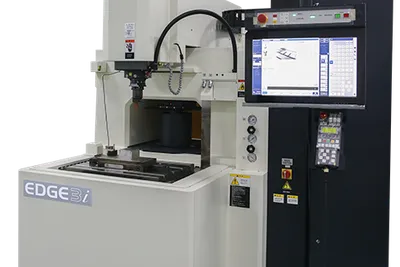
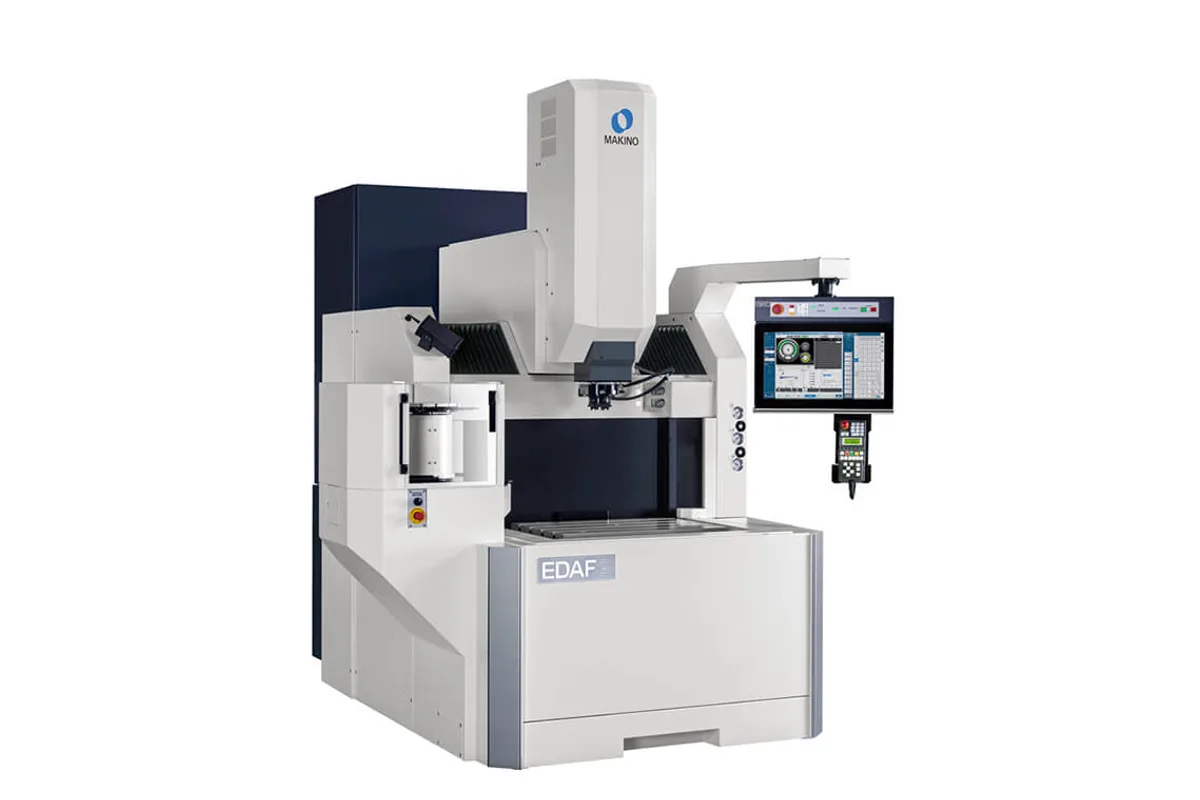
The Makino EDAF3 is the larger sibling in Makino's EDAF sinker EDM lineup, built for die and mold shops that need more stroke than the EDAF2 without giving up precision. It's manufactured in Singapore and shares the same rigid cast-iron construction as the EDAF2, but adds extra X/Y/Z travel to handle bigger cavities and multi-electrode setups.

Travel is 450 x 350 x 350 mm (17.7 x 13.8 x 13.8 in) on a 700 x 500 mm (27.6 x 19.7 in) worktable rated for 800 kg (1,764 lb). That's enough room to burn large injection mold cores or stack multiple smaller electrodes across the table. The three-sided programmable drop tank (850 x 650 x 400 mm internal) gives you unrestricted access for loading workpieces and integrating automation. When the tank drops, you've got a clear vantage point for setup and inspection.

Makino's Hyper-i touchscreen control runs the show. It's genuinely intuitive for EDM work. You describe your workpiece and electrode material, set your target finish, and the machine builds the burn strategy. Forum users describe it as 'touch screen your way through describing your work piece and electrode, then fiddle with it till it sounds like bacon.' The control includes HyperCut technology for reduced electrode wear, SuperSpark IV for faster metal removal, and ArcFree arc-prevention that monitors the gap and kills destructive DC arcs before they pit your finish.

The EDAF3 comes standard with a 16-position ATC and supports a C-axis MA head running up to 1,000 RPM for orbital burning and electrode rotation. The NC power supply delivers 40A peak current through an MGH6 unit. Integral thermal cooling of the Y- and Z-axis castings keeps the machine thermally stable during long unattended burns, though forum users warn you'll never get the best accuracy out of it unless you keep it in a climate-controlled space.

Rapid traverse runs at 5,000 mm/min (197 ipm). Machine weight sits at approximately 5,400 kg (11,900 lb), and the footprint is 1,500 x 2,610 mm (59.1 x 102.8 in). The dielectric reservoir is built into the base casting, which saves floor space and contributes to thermal stability. New machines typically price between $120,000 and $180,000 depending on configuration. Used units from 2013-2019 show up in the $45,000-$75,000 range. Specs sourced from Makino published data, dealer listings, and verified used-equipment marketplaces.

03

Full Specifications

Parameter Value
X-Axis Travel 450 mm (17.7 in)
Y-Axis Travel 350 mm (13.8 in)
Z-Axis Travel 350 mm (13.8 in)
Table Size 700 x 500 mm (27.6 x 19.7 in)
Max Workpiece Weight 800 kg (1,764 lb)
Max Electrode Weight 165 lbs
Tank Internal Dimensions 850 x 650 x 400 mm (33.5 x 25.6 x 15.7 in)
Dielectric Fluid Volume 450 liters (119 gal)
Nc Power Supply MGH6 (40A peak)
Rapid Traverse Rate 5,000 mm/min (197 ipm)
Atc Capacity 16 positions
C Axis Speed 1,000 RPM (MA Head)
Machine Dimensions 1,500 x 2,610 x 2,600 mm (59.1 x 102.8 x 102.4 in)
Machine Weight 5,400 kg (11,900 lb)
CNC Control Makino Hyper-i (touchscreen)
Eventscontent Librarywebinar Archiveownersmakino Expertisesafety Data Sheetsnewsroomfinancing Financing OptionsMakino makes it easy to upgrade with flexible financing optionsLearn More
Metric English
Tank Size850650400 Maximum Workpiece Weight:1,760 lbsTank Size:33.46" x 25.6" x 15.75"Max Electrode Weight:165 lbs
Tank Size 33.46" x 25.6" x 15.75"
Maximum Workpiece Weight 1,760 lbs

Specifications sourced from makino.com — verified 2026-03-28

04

Strengths & Limitations

Strengths

  • Three-sided programmable drop tank gives unrestricted workpiece access and simplifies automation integration for unattended burning
  • Hyper-i touchscreen control is genuinely intuitive for EDM operators, with guided setup that builds burn strategies from workpiece and electrode descriptions
  • ArcFree technology actively prevents destructive DC arcs, protecting surface finish quality on critical die and mold cavities
  • Integral thermal cooling of Y- and Z-axis castings maintains dimensional stability during long burns without relying solely on shop climate control
  • 16-position ATC with C-axis MA head (1,000 RPM) enables orbital burning and complex electrode strategies for unattended multi-cavity work
  • HyperCut technology reduces electrode wear, letting you achieve target finishes with fewer electrodes per cavity
  • Dielectric reservoir built into the base casting saves floor space and adds thermal mass for stability

Limitations

  • 40A peak current is adequate for most die/mold work but limits metal removal rate compared to machines with 60A+ power supplies on heavy roughing
  • At 5,400 kg (11,900 lb) and a 1.5 x 2.6 m footprint, floor loading and rigging costs need planning before installation
  • Makino sinker EDMs carry a significant price premium over competitors like Sodick or CHMER, with new EDAF3 machines starting north of $120K
  • Best accuracy requires a climate-controlled environment; shops without temperature/humidity control won't see the machine's full capability
  • Makino's service network is smaller than some competitors in certain regions, which can mean longer wait times for field service
05

Best For

Injection mold shops burning deep-rib cavities and complex core geometries that demand consistent surface finish across the full burn cycle Die shops running unattended overnight burns using the 16-position ATC and automation-friendly drop-tank design Shops stepping up from entry-level sinker EDMs that need better arc prevention and surface finish consistency on production tooling Medical and aerospace mold makers holding tight tolerances (sub-0.005 mm) on cavity details where electrode wear management is critical Production environments burning multiple cavities per setup on the 700 x 500 mm table with electrode rotation via the C-axis head Facilities that already run Makino wire or milling equipment and want to standardize on the Hyper-i control platform
06

Frequently Asked Questions

01 What does a Makino EDAF3 cost new and used?

New EDAF3 machines typically run $120,000-$180,000 depending on configuration (ATC size, C-axis head, fine-hole option). Used units from 2013-2019 sell in the $45,000-$75,000 range. A 2013 model with 16-tool ATC was listed at $48,000, while a 2019 unit with low hours (1,500 hr) sold for significantly more. European listings show prices around EUR 100,000 for recent-vintage machines.

02 What's the difference between the EDAF2 and EDAF3?

The EDAF3 offers larger X/Y/Z strokes (450/350/350 mm vs 350/250/250 mm on the EDAF2), a bigger worktable (700x500 vs 500x350 mm), and higher workpiece capacity (800 kg vs 500 kg). Forum users also note the EDAF3 has 'a beefier power supply and some other smoke and mirrors that make it better.' The EDAF3 shares the same rigid casting design and Hyper-i control as the EDAF2.

03 What is ArcFree technology and why does it matter?

ArcFree is Makino's real-time spark-gap monitoring system that detects and prevents destructive DC arcs before they damage the workpiece surface. DC arcs can pit cavity surfaces and ruin hours of finish burning in seconds. ArcFree reacts faster than the operator ever could, which is especially important during unattended overnight burns where nobody's watching the machine.

04 Can the EDAF3 do EDM hole drilling?

The standard EDAF3 is a sinker-only machine. However, Makino offers the EDAF3-FH (Fine Hole) variant that adds a removable W-axis die guide arm for high-precision EDM hole drilling. The arm installs and removes quickly, giving you both sinker and drilling capability on one machine. The Fine Hole option uses EDM dielectric oil instead of deionized water, which Makino says improves drilling accuracy and edge quality.

05 How does the EDAF3 compare to Sodick sinker EDMs?

Both are top-tier sinker EDMs. Makino's EDAF series is positioned for high-end die/mold work with an emphasis on surface finish and arc prevention. Sodick machines use linear motor drives for faster axis response. On Practical Machinist forums, a Makino regional sales manager describes the EDAF as 'technically the more advanced machine' designed for 'higher accuracies and finer surface finishes' compared to Makino's own EDGEi line. The choice often comes down to dealer support in your area and which control interface your operators prefer.

06 Do I need climate control for the EDAF3?

For best results, yes. Experienced EDM operators on forums are clear: 'You want your machine in a climate controlled space where you can hold temperature and humidity. You'll NEVER get the best it's capable of out of it if you just park it in a corner of the shop.' The EDAF3's integral thermal cooling helps, but it can't fully compensate for large ambient temperature swings.

07

Videos

Makino EDAF3 Sink from NCMT

Makino EDAF3 Sink from NCMT

MTDCNC

In Stock Makino EDAF3 Sink Machine, built for performance with no compromise

In Stock Makino EDAF3 Sink Machine, built for performance with no compromise

MTDCNC

Makino EDAF3 Demo

Makino EDAF3 Demo

Makino Inc.

Makino EDAF3 CNC Sinker EDM, 2011

Makino EDAF3 CNC Sinker EDM, 2011

EdgeMT

Makino EDAF3 H.E.A.T. Demo

Makino EDAF3 H.E.A.T. Demo

Makino Mexico

08

Community Discussions

09

Comparisons

10

Related Machines