Loeser BF 400
Key Specifications
bar diameter range
max workpiece length
belt width
belt speed
abrasive type
contact roll hardness
Overview
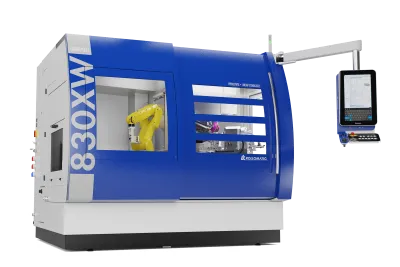
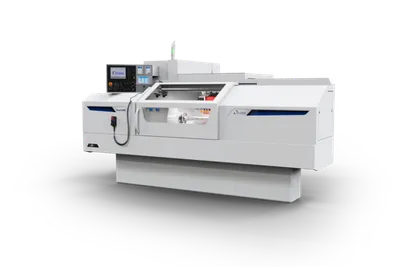
The Loeser BF 400 is a CNC belt grinding machine from Loeser GmbH of Remscheid, Germany, designed for surface finishing and deburring of bar stock, tubes, and cylindrical profiles up to 400 mm in length. The BF (Bandfinish/Belt Finish) designation indicates the machine's primary technology: continuous abrasive belt contact against the workpiece outer surface, producing a consistent surface finish (Ra 0.2–1.6 µm) across the full bar or tube length with accurate deburring, scale removal, and dimension reduction capability.
Bar stock belt grinding serves two primary market segments: pre-processing of steel and stainless steel bar stock for precision machining (centerless grinding preparation, turning pre-stock, and drawn-over-mandrel tube finishing) and post-processing of forged or cast bar components for surface quality improvement before heat treatment or final machining. The BF 400 handles bar diameters from 10 mm to 100 mm and lengths up to 400 mm (for individual component grinding) or in pass-through mode for continuous bar stock processing.
The BF 400's belt grinding head applies the abrasive belt to the bar surface with a controlled contact roll — a rubber or composite roller that presses the belt against the workpiece with CNC-programmed force. The bar rotates in a driven V-roller conveyor at programmable speed, while the belt traverses longitudinally to finish the full bar length. Grit progression (multiple belt heads in sequence) enables rough scale removal through to fine finishing in a single pass through the machine.
At $120,000–$250,000 depending on the number of belt heads and bar diameter range, the Loeser BF 400 competes with the Grindix and Timesavers belt grinding systems for bar stock finishing. Loeser's application focus on precision industrial components (rather than sheet metal or structural profiles) positions the BF 400 in precision bar stock and shaft blank preparation.
Full Specifications
| Parameter | Value |
|---|---|
| Bar Diameter Range | 10 - 100 mm (0.4 - 3.94 in) |
| Max Workpiece Length | 400 mm (15.7 in) per fixture; pass-through mode for longer bars |
| Belt Width | 100 mm (3.94 in) standard |
| Belt Speed | 10 - 35 m/s (programmable) |
| Abrasive Type | Aluminum oxide, zirconia alumina, or SiC belts; grit 36–320 |
| Contact Roll Hardness | Shore A 40–80 (application-specific selection) |
| Workpiece Rotation Speed | 20 - 200 RPM (V-roller drive) |
| Surface Finish Achievable | Ra 0.2 - 1.6 µm (depends on grit and bar material) |
| Material Removal | Up to 0.5 mm diameter per pass (rough grinding belts) |
| CNC Control | Siemens 828D with Loeser belt grinding software |
| Machine Weight | ~2,200 kg (4,850 lb) |
| Coolant | Dry or minimal oil mist (most bar grinding applications) |
Strengths & Limitations
Strengths
- Continuous abrasive belt grinding removes mill scale, forging skin, and surface defects from bar stock in a single pass, producing a consistent Ra 0.2–1.6 µm surface for downstream precision machining
- Variable belt grit and contact roll hardness selection accommodates a wide range of bar materials — mild steel, stainless steel, aluminum, titanium, and Inconel — with appropriate belt specifications for each
- CNC-controlled belt contact force and workpiece rotation speed enables recipe-based processing for different bar diameters and surface finish targets without manual setup adjustment
- Pass-through configuration option enables continuous bar stock processing for longer bars beyond the 400 mm fixture capacity — feeding bar stock through the machine in a continuous pass
- Belt grinding generates lower heat than grinding wheel operations, reducing risk of surface thermal damage (burning) on hardened or stainless steel bar stock
Limitations
- Abrasive belt consumption is the primary operating cost — rough-grit belts used for scale removal and aggressive stock removal have relatively short belt life on abrasive-resistant bar materials
- Belt grinding is less precise for dimensional control than centerless grinding — it is a surface finishing and scale removal process, not a precision sizing process (±0.01 mm dimensional control requires centerless grinding)
- Maximum bar diameter of 100 mm limits coverage to small and medium bar stock — larger diameter bars (> 100 mm) require larger BF machine platforms
Best For
Frequently Asked Questions
01
Belt grinding uses a continuous abrasive belt driven over contact rolls to abrade the workpiece surface. The belt conforms somewhat to the workpiece surface (the contact roll's rubber hardness determines how much the belt follows surface irregularities), producing surface finish improvement and stock removal without the precise diameter control of centerless grinding. Centerless grinding uses a precision grinding wheel and regulating wheel to produce tight diameter tolerance (±0.005 mm) and roundness (< 0.002 mm) on the bar. Belt grinding is used for scale removal, surface finish improvement, and moderate material removal where dimensional precision is secondary; centerless grinding is used for precision diameter and roundness control. Many bar stock operations use belt grinding (BF 400) first for scale removal, then centerless grinding for precision sizing.
02
Stainless steel bar grinding requires abrasive belts that resist loading (clogging with stainless steel smear) and generate minimal heat. Zirconia alumina (ZA) belts are preferred for stainless steel — ZA abrasive grains are tougher than standard aluminum oxide and fracture to expose fresh sharp cutting edges rather than dulling and loading. Silicon carbide belts are used for stainless applications requiring minimum surface heat. Belt grit for scale removal on hot-rolled stainless is typically 36–80 grit; for final finish on cold-drawn stainless, 120–240 grit. Open-coat belt construction (abrasive grains spaced wider than on close-coat belts) reduces loading on sticky materials like stainless and aluminum.
03
Yes, with appropriate tooling and parameters. Titanium is notoriously difficult to grind due to its low thermal conductivity (heat builds up at the cutting zone) and tendency to work-harden and smear rather than cut cleanly. For titanium bar grinding on the BF 400, silicon carbide (SiC) belts in medium-fine grit (60–120) are preferred, with the lowest practical belt speed (10–15 m/s) to minimize grinding temperature and lightest practical contact pressure to prevent workpiece surface burning. Titanium generates highly flammable titanium swarf — the machine must be equipped with appropriate spark containment, fire suppression, and titanium-safe dust collection. Loeser provides titanium-safe machine configurations for aerospace bar grinding applications.
04
In pass-through mode, the BF 400's bar feed conveyor drives the bar stock axially through the belt grinding head zone continuously — the bar rotates in driven V-rollers while advancing axially past the stationary belt contact zone. Belt grinding head position, contact force, and bar rotation speed are CNC-programmed. Bar feed rate (axial advance speed) determines the helix angle of the surface texture relative to the bar axis and the material removal depth per pass. Multiple passes (reverse direction) with the same or different belt grit produce the target surface finish. Pass-through mode handles bars up to the V-roller conveyor length — typically 2,000–6,000 mm — far beyond the 400 mm fixturing capacity.
05
The Loeser BF (Belt Finish) series uses flat or curved abrasive belts running longitudinally against the bar surface to produce a longitudinal surface texture — primarily for bar stock preparation and shaft surface finishing. The Loeser RF (Rotary Finish) series uses rotating abrasive discs or pads in a face-contact geometry against the component, producing a more isotropic (non-directional) or circumferential surface texture — primarily for round component end-face finishing, bearing surface polishing, and round component decorative finishing. BF is for cylindrical OD surface finishing; RF is for face finishing and round component all-surface polishing. Some components require both operations: BF for the cylindrical surface, RF for the face surfaces.
Videos

Beck

Poker Night in America

Christian Loeser - Topic

Creed

Loserfruit
Community Discussions
Pricing and buying discussion — Need Help! Fanuc OM-B / Cortini BF400 can't move axes after ...
Community discussion — Microsoft Word - Tool Setter Calibration.doc - CNCzone
Community discussion — Fanuc rom files - CNCzone
Community discussion — BOSS Laser - CNCzone
Pricing and buying discussion — What kind of Coolant does your shop use? : r/Machinists - Reddit
Community discussion — What's your favorite anti-rust spray? : r/Machinists - Reddit
Pricing and buying discussion — Quiet air compressor recommendations? : r/Machinists - Reddit
Community discussion — Why would this happen on a swiss type? : r/Machinists - Reddit
Links to community discussions. Summaries are editorial — visit the original thread for full context.