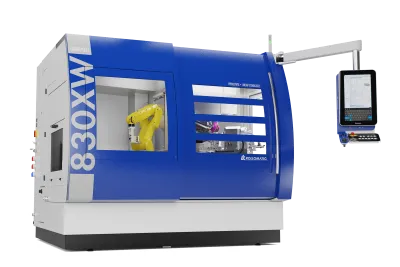
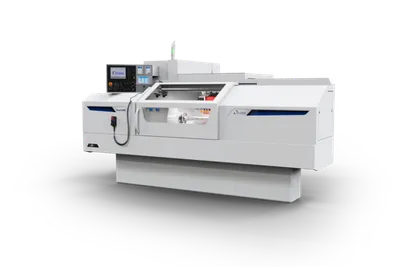
Hegenscheidt-MFD RP 750
Key Specifications
machine type
max wheel diameter
min wheel diameter
max axle length
max wheel set weight
profile accuracy
Overview
The Hegenscheidt-MFD RP 750 is a CNC wheel set reprofiling lathe designed for the precision turning and reprofiling of railway and locomotive wheel sets removed from rail vehicles — a wheel-out, shop-floor approach complementary to Hegenscheidt's underfloor UHB series. The RP 750 handles wheel sets with tread diameters up to 750mm, covering the range of large-diameter wheel sets used on mainline locomotives, heavy freight wagons, and large-diameter metro cars. Hegenscheidt-MFD, as the global leader in railway wheelset machining systems, offers the RP series for depot and wheel shop facilities where extracted wheel sets are brought to a dedicated wheelset turning/reprofiling cell rather than the underfloor approach that serves through-the-depot vehicle maintenance workflows.
The RP 750 operates on extracted wheel sets: the axle with both wheels is mounted between centers in the machine's headstock and tailstock arrangement, with CNC-controlled turning tools profiling the wheel tread and flange to the specified profile geometry. This between-centers wheel set turning approach ensures that the tread profile is generated relative to the axle centerline — maintaining the critical concentricity between the wheel tread running surface and the bearing seat journals on the axle that ensures smooth, low-vibration rolling contact in service. For wheel sets where out-of-roundness, flat spots, or asymmetric wear require restoration, the RP 750 provides the between-centers turning precision that is the standard for high-quality wheel set reprofiling.
The RP 750 incorporates CNC profile measurement and automatic profile selection — the operator identifies the vehicle type and selects the target profile from the machine's profile library, and the CNC calculates the turning program to produce the specified profile geometry in minimum passes. Post-machining profilometry measurement verifies that the wheel meets specification and generates the maintenance record required for wheel set service life tracking. The machine's CNC control coordinates simultaneous cutting of both wheels on the axle, ensuring matched tread diameters (within specification) between the two wheels of the pair — a critical requirement for minimizing wheel set hunting and maintaining stable high-speed operation.
Installed in wheel shops at major railway maintenance facilities — locomotive depots, rolling stock overhaul workshops, and specialized wheelset maintenance contractors — the RP 750 represents the industrial-grade precision end of railway wheelset reprofiling. A new RP 750 installation typically prices between $800,000 and $1,800,000 depending on configuration, options, and ancillary equipment (handling, measurement, wheel press integration). Hegenscheidt-MFD supports RP series machines with global service, spare parts, and profile tooling supply from their German manufacturing and global service organization.
Full Specifications
| Parameter | Value |
|---|---|
| Machine Type | CNC between-centers wheel set reprofiling lathe |
| Max Wheel Diameter | 750 mm (29.5 in) tread diameter |
| Min Wheel Diameter | 350 mm (13.8 in) |
| Max Axle Length | 2,200 mm (86.6 in) between bearing seats |
| Max Wheel Set Weight | 4,000 kg (8,818 lb) |
| Profile Accuracy | ±0.05 mm tread profile; ±0.1 mm flange |
| Roundness After Reprofiling | < 0.05 mm |
| Turning Method | CNC carbide insert profiling, both wheels simultaneously |
| Tread Diameter Matching | < 0.1 mm difference left-right after reprofiling |
| Measurement System | Integrated pre/post CNC profile gauging |
| Profile Library | Standard and custom profiles stored in control |
| Spindle Drive | Variable speed, 15-55 kW (application-dependent) |
| CNC Control | Siemens Sinumerik 840D sl |
| Machine Footprint | Approx. 6,000 x 3,500 mm (installation-specific) |
Strengths & Limitations
Strengths
- Between-centers turning ensures wheel tread profile is concentric with the axle journal bearing seats — the fundamental precision requirement for quality wheel set reprofiling that underfloor machines cannot match for severely worn or damaged wheel sets
- 750mm maximum wheel diameter accommodates the full range of mainline locomotive, heavy freight, and large-diameter metro wheel sets that exceed the capacity of smaller wheel reprofiling machines
- Simultaneous CNC profiling of both wheels on the axle ensures matched tread diameters within specification — critical for minimizing hunting, reducing dynamic forces, and maintaining stable vehicle dynamics at speed
- ±0.05mm tread profile accuracy and <0.05mm post-reprofiling roundness delivers wheel quality that meets the stringent specifications of high-speed rail operators and national railways with tight wheel/track geometry standards
- Siemens Sinumerik 840D sl control with integrated profile library and automatic program generation reduces operator skill requirements and ensures consistent profile accuracy across different wheel set types
Limitations
- Wheel-out operation requires wheel set extraction from the vehicle — unlike underfloor machines, the RP 750 is not a rapid-turnaround solution; vehicle downtime includes the time to extract and reinstall the wheel sets in addition to machining time
- Capital investment of $800K-$1.8M requires sufficient wheel set reprofiling volume to justify — smaller depots or low-frequency maintenance operations may find the throughput requirement difficult to achieve
- Machine footprint of approximately 6,000 x 3,500 mm plus material handling space requires significant dedicated floor area in the wheel shop, and the overhead crane or hoist capacity for 4,000 kg axle handling must be present or installed
Best For
Frequently Asked Questions
01
The UHB 500 is an underfloor machine — the rail vehicle drives onto the machine and wheel sets are reprofiled without extraction from the vehicle. The RP 750 is a between-centers wheel reprofiling lathe for extracted wheel sets — the axle is removed from the vehicle and mounted in the machine for reprofiling. The UHB 500 is faster for routine maintenance (30-90 minute vehicle turnaround), while the RP 750 handles larger wheel diameters (up to 750mm vs 500mm reprofiling range), provides higher precision between-centers reprofiling, and is suited to heavy overhaul workflows where wheel set extraction is already part of the scope.
02
When a wheel set is turned between centers — with driving and supporting centers engaging the center holes in each end of the axle — the tread profile is generated with the wheel rotating about the true axle centerline. This ensures that the reprofiled tread is concentric with the axle journal bearing seats to within the machine's accuracy (roundness <0.05mm). If the tread is not concentric with the journals, the wheel set runs eccentrically in service, producing vibration and noise even with a geometrically correct tread profile. Between-centers reprofiling is the precision standard for quality wheel set maintenance.
03
The RP 750's CNC control measures the tread diameter of both wheels before machining, calculates the maximum diameter that can be achieved on the worn wheel (limited by the smaller-diameter wheel's condition), and sets the target tread diameter for both wheels to match within specification (typically <0.1mm difference). Both wheels are turned simultaneously to the matching target diameter. This matched-diameter result is critical — a wheel set with mismatched tread diameters will tend to steer the vehicle in the direction of the larger wheel, increasing wheel flange and rail wear.
04
The carbide profiling inserts must be replaced periodically — insert life depends on wheel material (cast iron vs steel), wear condition (lightly worn vs heavily worn with hard spots), and cutting parameters. Typical insert life is 40-120 wheel sets per insert, depending on conditions. The profile accuracy of the machine should be verified periodically using a calibrated profile gauge — Hegenscheidt recommends formal machine calibration annually, with regular in-process verification as part of quality system requirements for wheel set maintenance.
05
Yes. The RP 750 requires a level, reinforced concrete floor rated for the machine weight plus the maximum wheel set handling loads, with sufficient bay height for overhead crane access (minimum 5m under hook for 4,000 kg axle handling). Three-phase electrical service (460V or 380V depending on region) at 150-250 kW connected load is required. Chip conveyor and coolant system utilities must be designed into the installation. Hegenscheidt-MFD provides installation engineering documentation as part of the machine supply and recommends early engagement with the civil contractor for new wheel shop facilities.
Videos

Oh! Online
Community Discussions
Comparison and buying advice — anyone using Rego-Fix PowRgrip? - Practical Machinist
Troubleshooting and problem-solving — Rego-Fix Powrgrip system - Practical Machinist
Community discussion — Fillet Rolling Surface Finish | Practical ...
Community discussion — Need help identifying milling machine ...
Community discussion — railroad - cnczone.com
Community discussion — Plasma Hand Torch Conversion - CNCzone
Community discussion — HEIDENHAIN -> TNC - CNCzone
Community discussion — HEIDENHAIN - CNCzone
Links to community discussions. Summaries are editorial — visit the original thread for full context.