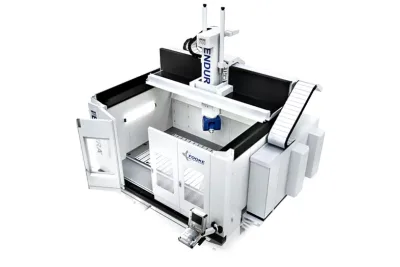
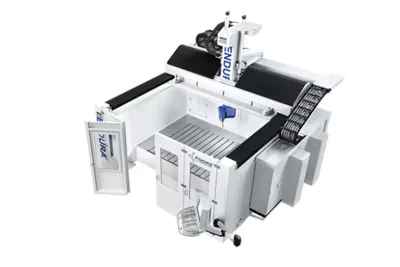
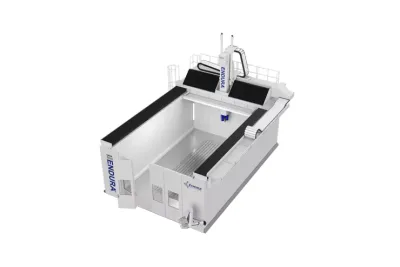
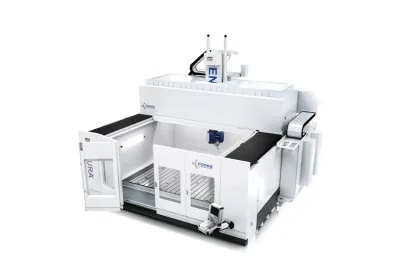
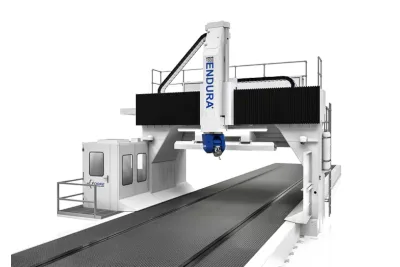
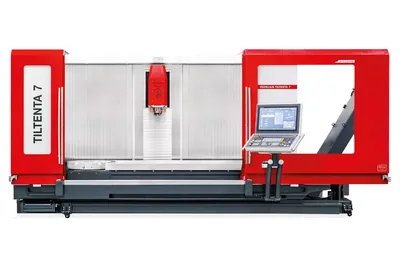
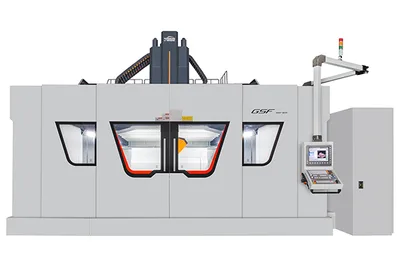
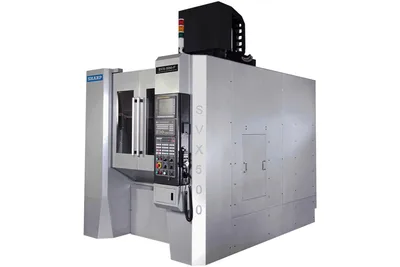
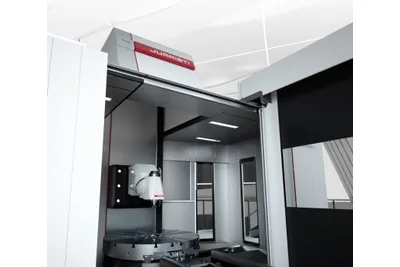
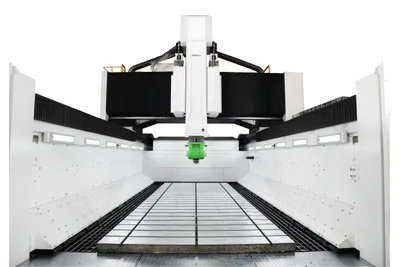
Fooke ENDURA 901L
This model was not found in Fooke's current lineup when we checked on 2026-10-03 . It may be a superseded or older model; the specifications below are as we last recorded them.
Key Specifications
Max Spindle
Spindle Taper
Rapid Traverse
Spindle Power
Accuracy
x axis travel
How much does the Fooke ENDURA 901L cost?
Estimated price range
Our best estimate for a 5-axis machining center in this class — not a quote from Fooke. Configuration moves it a long way.
Overview
The Fooke ENDURA 901L is a 5-axis machining center with a long, shallow envelope: 9,000 mm (354 in) of X as standard, described as expandable, against 3,500 mm (138 in) of Y and 1,000 mm (39.4 in) of Z. Its spindle is a fast one, 30,000 RPM on HSK-A63 with 60 kW (80.4 hp). The model is not in Fooke's current lineup, and the listed figures have not been confirmed against a maker page.
X rapids at 60 m/min while Y and Z move at 30 m/min. The long axis is the quick one, which suits parts that are mostly traversed lengthwise. With 1,000 mm (39.4 in) of Z, part height plus tool length has to stay modest, so the natural work is flat or gently contoured. Both rotary axes run on direct-drive torque motors. B tilts ±120° and C turns 360° continuous, which leaves no C-axis unwind to program around.
The base is polymer concrete (mineral cast) and the typical weight is given as ~120,000 kg (264,555 lb), a figure that sets the foundation and rigging work for any relocation. Positioning accuracy is listed as < 0.010 mm over full travel and the control as Siemens Sinumerik 840D sl. For scale within the family, the Endura 904 is listed with 39 kW and max. 24,000 min-1.
Full Specifications
| Parameter | Value |
|---|---|
| X Axis Travel | 9,000 mm (354 in) standard; expandable |
| Y Axis Travel | 3,500 mm (138 in) |
| Z Axis Travel | 1,000 mm (39.4 in) |
| B Axis Tilt | ±120° |
| C Axis Rotation | 360° continuous |
| B C Axis Drive | Direct-drive torque motors |
| Max Spindle Speed | 30,000 RPM |
| Spindle Taper | HSK-A63 |
| Spindle Motor Power | 60 kW (80.4 hp) |
| Rapid Traverse Rate | 60 m/min (X), 30 m/min (Y/Z) |
| Positioning Accuracy | < 0.010 mm over full travel |
| Machine Base | Polymer concrete (mineral cast) |
| CNC Control | Siemens Sinumerik 840D sl |
| Machine Weight | ~120,000 kg (264,555 lb) typical |
Specifications compiled from manufacturer literature and industry references. Not independently verified against a published spec sheet — confirm with the manufacturer or an authorised dealer before making a purchasing decision.
Strengths & Limitations
Strengths
- 30,000 RPM spindle on HSK-A63 with 60 kW (80.4 hp) in the listed figures
- 9,000 mm (354 in) of X travel as standard, listed as expandable
- X rapids of 60 m/min, with 30 m/min on Y and Z
- B tilt of ±120° and 360° continuous C, both on direct-drive torque motors
- Polymer concrete (mineral cast) base and a listed positioning accuracy of < 0.010 mm over full travel
Limitations
- Z travel is 1,000 mm (39.4 in), which rules out tall parts and deep cavities reached from above
- HSK-A63 at 30,000 RPM is a small-tool spindle; no high-torque head or larger interface is listed for heavy roughing
- A typical weight of ~120,000 kg (264,555 lb) means a prepared foundation and heavy rigging for any move
- No tool magazine capacity, table load or repeatability row is listed
Best For
Frequently Asked Questions
01
The listed figures are 9,000 mm (354 in) in X as standard, with X described as expandable, 3,500 mm (138 in) in Y and 1,000 mm (39.4 in) in Z. Z is the tight one: it limits part height plus tool length to what fits under the head.
02
A 30,000 RPM spindle with an HSK-A63 interface and 60 kW (80.4 hp). No torque figure and no alternative head are listed, so the table describes a single high-speed configuration.
03
Rapid traverse is listed as 60 m/min in X and 30 m/min in Y and Z. The rotary axes, B at ±120° and C at 360° continuous, use direct-drive torque motors; no rotary speed is listed.
04
The Endura 904 is listed with a 39 kW spindle at max. 24,000 min-1. The ENDURA 901L is listed with 60 kW (80.4 hp) and 30,000 RPM on HSK-A63, so on paper it has the faster and more powerful spindle of the two.