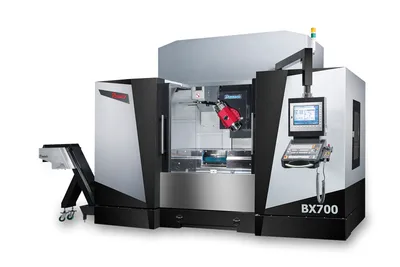
Fidia HSS K165
This model was not found in Fidia's current lineup when we checked on 2026-10-03 . It may be a superseded or older model; the specifications below are as we last recorded them.
Key Specifications
Spindle Taper
Table Size
Rapid Traverse
Spindle Power
machine type
x travel
How much does the Fidia HSS K165 cost?
Estimated price range
Our best estimate for a 5-axis machining center in this class — not a quote from Fidia. Configuration moves it a long way.
Overview
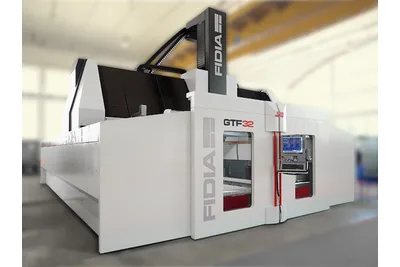
The Fidia HSS K165 is listed as a high-speed 5-axis gantry machining center with a 42,000 RPM HSS electrospindle, linear motor axes and a 20-position automatic tool changer. It is not in Fidia's current lineup, so this page mainly serves someone assessing an older machine, and the listed figures have not been confirmed against a maker document.
The head and spindle rows agree with each other: an A axis of +/- 110°, a C axis of 360° continuous, an HSK-A63 taper and 55 kW of spindle power. The frame is described as a moving gantry on linear guides with a cast iron/Zanite structure, and the linear motor axes are listed at 60 m/min rapid traverse and 1 g acceleration. Those are figures for light, fast finishing passes in which the axes reverse constantly, the kind of cutting a 42,000 RPM spindle is run at.
The rest of the table carries two sets of numbers, and a buyer should not assume which one applies. One set gives travels of 1,650 mm (65 in) in X, 900 mm (35.4 in) in Y and 700 mm (27.6 in) in Z. The other gives 3,150 mm, 1,850 mm and 1,000 mm, together with a 3,000 x 1,600 mm table, a table capacity of 5,000 kg/m², a machining height of 1,175 mm, rapid feeds of 30 m/min in X and Y and 24 m/min in Z, and a spindle speed of 24,000 rpm. A 3,000 x 1,600 mm table cannot sit inside 1,650 mm of X travel, so the two sets most likely describe different machines or configurations.
Read the travels, spindle speed and table size off the machine's own plate and documentation before relying on any of them. The control is listed as a Fidia proprietary CNC (C20).
Full Specifications
| Parameter | Value |
|---|---|
| Machine Type | High-speed 5-axis gantry machining center |
| X Travel | 1,650 mm (65 in) |
| Y Travel | 900 mm (35.4 in) |
| Z Travel | 700 mm (27.6 in) |
| A Axis Range | +/- 110° |
| C Axis Range | 360° continuous |
| Spindle Speed | 42,000 RPM (HSS electrospindle) |
| Spindle Motor Power | 55 kW |
| Spindle Taper | HSK-A63 |
| Rapid Traverse Rate | 60 m/min (linear motor axes) |
| Acceleration | 1 g (linear motor axes) |
| Tool Changer | Automatic, 20-position |
| CNC Control | Fidia proprietary CNC (C20 / NUM-based) |
| Frame | Moving gantry on linear guides, cast iron/Zanite structure |
| Spindle Speeds | 24,000 rpm |
| Machining Height | 1,175 mm |
| X Axis Travel | 3,150 mm |
| Y Axis Travel | 1,850 mm |
| Z Axis Travel | 1,000 mm |
| Table Size | 3,000 x 1,600 mm |
| Table Capacity | 5,000 kg/m² |
| Rapid Feed X Y | 30 m/min |
| Rapid Feed Z | 24 m/min |
Specifications compiled from manufacturer literature and industry references. Not independently verified against a published spec sheet — confirm with the manufacturer or an authorised dealer before making a purchasing decision.
Strengths & Limitations
Strengths
- Listed with a 42,000 RPM HSS electrospindle on an HSK-A63 taper, a pairing suited to small-tool finishing
- Linear motor axes are listed at 60 m/min rapid traverse and 1 g acceleration
- The head is listed with +/- 110° on the A axis and 360° continuous rotation on C
- Spindle power is listed at 55 kW
- The frame row describes a moving gantry on linear guides with a cast iron/Zanite structure
Limitations
- Not in Fidia's current lineup, and the listed figures have not been confirmed against a maker document
- The table holds two travel sets, 1,650 mm (65 in) by 900 mm (35.4 in) by 700 mm (27.6 in) and 3,150 mm by 1,850 mm by 1,000 mm, without saying which applies
- Spindle speed appears as both 42,000 RPM and 24,000 rpm, and X and Y rapids as both 60 m/min and 30 m/min, so each has to be confirmed on the machine
- The tool changer is listed at 20 positions, a small magazine for long multi-tool programs
Best For
Frequently Asked Questions
01
No. The HSS K165 is not in Fidia's current lineup and may be an older model. The listed figures on this page have not been confirmed against a maker document, so use them as a starting point and check them against the paperwork of the specific machine.
02
The listed figures give two sets. One is 1,650 mm (65 in) in X, 900 mm (35.4 in) in Y and 700 mm (27.6 in) in Z. The other is 3,150 mm, 1,850 mm and 1,000 mm, alongside a 3,000 x 1,600 mm table. The table does not say which set belongs to which version, so measure or read the plate on the machine being considered.
03
A 42,000 RPM HSS electrospindle with an HSK-A63 taper and 55 kW of spindle power. A second row gives a spindle speed of 24,000 rpm, which points to more than one spindle having been fitted. Confirm the spindle on the machine itself.
04
The A axis is listed at +/- 110° and the C axis at 360° continuous. Continuous C rotation means the head does not have to unwind during a long contouring pass around a part.
05
The linear motor axes are listed at 60 m/min rapid traverse with 1 g acceleration. A second pair of rows gives rapid feeds of 30 m/min in X and Y and 24 m/min in Z. The two do not agree, so the rapid rate is another figure to verify on the machine.
More from Fidia
Other 5-Axis Machining Centers
Matec FUV170T
Chiron MILL 800 Five Axis Baseline
Anderson FUV-170
Hartford HSA-420EAY
Anger Machining SK800T