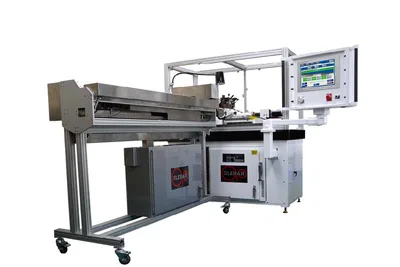
EWAG RS 15
Key Specifications
X Travel
Y Travel
Z Travel
a axis
b axis
workpiece slide z contact pressure
How much does the EWAG RS 15 cost?
Estimated price range
Our best estimate for a cnc grinding machine in this class — not a quote from United Grinding (EWAG). Configuration moves it a long way.
Overview
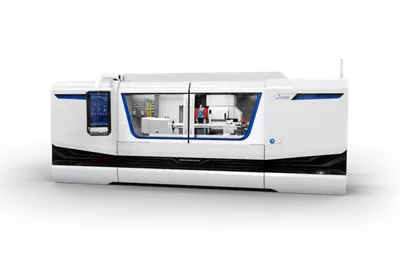
The EWAG RS 15 is a small tool grinder with a 2.2 kW grinding spindle that runs at 1,000 – 6,000 rpm on wheels up to 150 mm. What sets it apart is that it grinds under controlled force: the workpiece slide in Z applies a contact pressure adjustable from 0 – 400 N.
Oscillation is the second defining feature. The oscillation size is adjustable from 0 – 70 mm and the frequency from 0 – 60 strokes/min, so the tool edge sweeps back and forth over the wheel face while the slide holds its pressure. Grinding by pressure and sweep, not by a fixed infeed, is the established way to work very hard cutting materials without chipping the edge or glazing the wheel. The table does not name the materials, so confirm suitability for yours.
Travels are 490 mm in X, 130 mm in Y and 120 mm in Z. The A axis covers - 10 to + 27° and the B axis 235°, a range wide enough to bring a radius or corner around the wheel in one setup. Resolution is 0.001 mm linear and 0.01° radial.
Two workholding units appear in the table, the TA 55 dividing head and the axis angle grinding device AWS, and both are listed with HSK 63. Tooling on that interface therefore mounts on either unit without an adapter. No weight, footprint or power supply figures are listed.
Full Specifications
| Parameter | Value |
|---|---|
| X-Axis Travel | 490 mm |
| Y-Axis Travel | 130 mm |
| Z-Axis Travel | 120 mm |
| A Axis | - 10 to + 27° |
| B Axis | 235° |
| Workpiece Slide Z Contact Pressure | 0 – 400 N |
| Oscillation Size | 0 – 70 mm |
| Oscillation Frequency | 0 – 60 strokes/min |
| Linear Resolution | 0.001 mm |
| Radial Resolution | 0.01° |
| Grinding Spindle Performance | 2.2 kW |
| Grinding Spindle Speed | 1,000 – 6,000 rpm |
| Max Grinding Wheel Diameter | 150 mm |
| Ta 55 Dividing Head | HSK 63 |
| Axis Angle Grinding Device Aws | HSK 63 |
Specifications sourced from ewag.com — verified 2026-10-03
Strengths & Limitations
Strengths
- Contact pressure on the workpiece slide Z adjustable from 0 – 400 N
- Oscillation adjustable in size (0 – 70 mm) and in frequency (0 – 60 strokes/min)
- B axis range of 235° and an A axis covering - 10 to + 27°
- The TA 55 dividing head and the axis angle grinding device AWS are both listed with HSK 63
- Grinding spindle speed adjustable over 1,000 – 6,000 rpm
Limitations
- Grinding spindle performance is 2.2 kW, enough for edge work and little else
- The maximum grinding wheel diameter is 150 mm
- Resolution is 0.001 mm linear and 0.01° radial, coarser than the 0.0001 mm of the EWAG Compact Line
- Y travel of 130 mm and Z travel of 120 mm restrict the size of tool that fits
Best For
Frequently Asked Questions
01
By force and oscillation. The workpiece slide in Z applies a contact pressure of 0 – 400 N, while the oscillation is set by size, 0 – 70 mm, and frequency, 0 – 60 strokes/min. The operator chooses pressure, stroke and rate to suit the edge being ground.
02
X travel is 490 mm, Y travel 130 mm and Z travel 120 mm. The A axis covers - 10 to + 27° and the B axis 235°. Linear resolution is 0.001 mm and radial resolution is 0.01°.
03
The grinding spindle performance is 2.2 kW and its speed range is 1,000 – 6,000 rpm. The maximum grinding wheel diameter is 150 mm. That combination is sized for finishing edges under light, controlled pressure.
04
The table lists two units, the TA 55 dividing head and the axis angle grinding device AWS, each with an HSK 63 interface. Ask EWAG which of the two is part of the base machine and which adapters exist for tools that are not on HSK 63.
05
The EWAG Compact Line has travels of 450 mm, 180 mm and 150 mm and a 15 m/min X rapid, and it is built for indexable inserts. The RS 15 has 490 mm, 130 mm and 120 mm and grinds under a set contact pressure of up to 400 N, which suits individual tools and small batches.
Videos

Tarif Technical

Tarif Technical