Danobat SL 400
Key Specifications
max crankshaft length
max throw radius
main journal diameter range
crank pin diameter range
grinding wheel speed
grinding wheel diameter
Overview
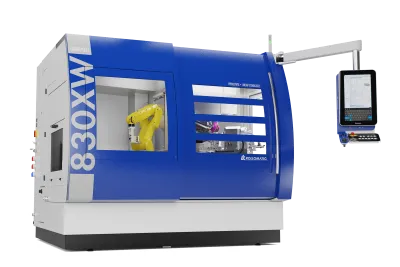
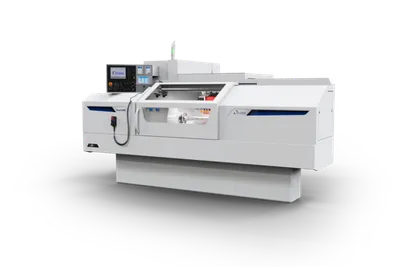
The Danobat SL 400 is a CNC crankshaft and non-round grinding machine from Danobat Group (Elgoibar, Basque Country, Spain), designed specifically for the automotive and heavy equipment sectors where crankshaft journal grinding is a critical precision manufacturing process. The SL series machines use CBN (cubic boron nitride) abrasive grinding wheels and high-speed spindle technology for productive crankshaft pin grinding — a demanding application where the grinding wheel must follow the eccentric motion of the crankpin while maintaining the programmed stock removal rate and geometric accuracy across all journals.
The SL 400 employs Danobat's proven pendulum grinding strategy for crankshaft applications: the grinding wheel oscillates in synchronization with the rotating crankshaft to maintain constant contact with the eccentric journal being ground. This CNC-controlled synchronous motion requires precise coordination between the workhead rotation (C axis) and the grinding wheel infeed (X axis), managed by the Siemens 840D sl CNC that Danobat specifies for its crankshaft grinders. The result is uniform stock removal across all journals, predictable cycle times, and the sub-micron dimensional repeatability required by automotive engine assembly lines.
Danobat's crankshaft grinding expertise extends to the SL 400's peripheral systems: dedicated coolant delivery systems optimized for CBN wheel grinding, automatic wheel balancing, and in-process gauging from Marposs are integrated into the machine architecture. The SL 400 can grind both main journals and connecting rod (crank) pins in a single setup on crankshafts up to 400 mm throw, covering applications from 4-cylinder passenger car engines through 6-cylinder truck engines. Workpiece handling automation interfaces (robot or gantry loader) are available to support automated production line integration.
Priced in the $400,000–$700,000 range, the Danobat SL 400 competes with Naxos-Union, Junker JUCRANK, and Schaudt Mikrosa (United Grinding) in the automotive crankshaft grinding market. Danobat's Basque Country manufacturing heritage, combined with its Overbeck and Danobat-Landis acquisitions, has created a grinding machine portfolio with genuine crankshaft grinding application depth, particularly for European automotive powertrain manufacturers.
Full Specifications
| Parameter | Value |
|---|---|
| Max Crankshaft Length | 800 mm (31.5 in) |
| Max Throw Radius | 200 mm (7.9 in) — 400 mm total crank throw |
| Main Journal Diameter Range | 30 - 120 mm |
| Crank Pin Diameter Range | 30 - 100 mm |
| Grinding Wheel Speed | Up to 120 m/s (CBN) |
| Grinding Wheel Diameter | 500 mm (19.7 in) |
| C Axis Resolution | 0.0001° |
| X Axis Resolution | 0.0001 mm (0.1 µm) |
| Journal Roundness | < 0.001 mm (1 µm) |
| Journal Surface Finish | Ra 0.1 - 0.4 µm |
| In Process Gauging | Marposs standard |
| CNC Control | Siemens 840D sl |
| Automation Interface | Robot/gantry loader ready |
| Machine Weight | ~18,000 kg (39,683 lb) |
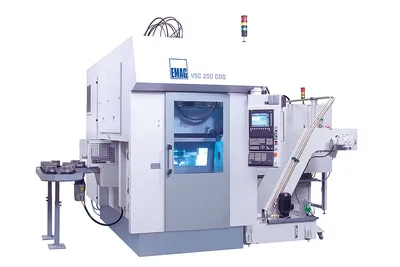
| Manufacturer | Emag |
| Model | VSC 250 |
| Power Requirement | 60 kW |
| Grinding Length | 1,016 mm |
Specifications sourced from machinio.com — verified 2026-03-28
Strengths & Limitations
Strengths
- Synchronous CNC pendulum grinding strategy enables precise eccentric journal grinding of crankpins with consistent stock removal and predictable cycle times
- CBN wheel capability at up to 120 m/s enables high-speed grinding for automotive production volumes with dramatically longer wheel life than conventional abrasives
- Integrated Marposs in-process gauging delivers closed-loop size control — eliminates operator gauge-and-adjust cycles on high-volume crankshaft production lines
- Single-setup main journal and crankpin grinding capability eliminates intermediate fixturing and re-clamping for complete crankshaft grinding
- Robot and gantry loader interface supports automated cell integration for unmanned production in automotive powertrain manufacturing environments
Limitations
- High capital cost ($400,000–$700,000) makes the SL 400 a dedicated production investment rather than a flexible job shop machine
- Specialized crankshaft grinding application limits machine flexibility — cannot easily pivot to general cylindrical grinding work between crankshaft programs
- Danobat crankshaft grinding applications support in North America is limited — European buyers benefit from stronger local applications engineering resources
Best For
Frequently Asked Questions
01
Pendulum grinding (also called CBN crankshaft grinding or orbital grinding) is the technique used to grind eccentric crankpins on a rotating crankshaft. The crankpin rotates in an eccentric circular path as the crankshaft turns — the grinding wheel must continuously follow this eccentric motion to maintain contact. The CNC coordinates the C axis (crankshaft rotation) with the X axis (grinding wheel infeed) so that the wheel tracks the crankpin orbit and grinds at the programmed stock removal rate throughout the rotation. This requires very high CNC interpolation accuracy — the Siemens 840D sl on the SL 400 manages this coordination at 0.0001° C-axis and 0.0001 mm X-axis resolution.
02
CBN (cubic boron nitride) is the second hardest abrasive material after diamond and is specifically suited to high-speed grinding of hardened ferrous metals. In crankshaft grinding, CBN wheels operate at 80–120 m/s (versus 45 m/s for conventional aluminum oxide wheels) and maintain their cutting geometry for hundreds of crankshafts between dresses — a conventional wheel wears rapidly and requires frequent dressing. The result is consistent journal geometry across large production batches, shorter cycle times (higher feed rates possible at CBN wheel speeds), and predictable tooling cost per part. The higher CBN wheel cost ($5,000–$15,000 per wheel) is offset by the dramatically longer wheel life in automotive production volumes.
03
The SL 400 handles crankshafts up to 800 mm in length between centers with a maximum throw radius of 200 mm (400 mm total crank throw). Journal diameters from 30–120 mm on main journals and 30–100 mm on crankpins are within the machine's grinding range. This covers 4-cylinder passenger car crankshafts (typically 400–600 mm long, 50–70 mm journal diameter), 6-cylinder car and light truck crankshafts (600–750 mm, 60–80 mm journals), and some smaller commercial diesel crankshafts. Very large diesel crankshafts (marine, locomotive) require dedicated large-capacity crankshaft grinders beyond the SL 400's envelope.
04
The SL 400 is optimized for crankshaft grinding (main journals and crank pins). Camshaft grinding is a related but different process — camshaft lobes have non-circular, mathematically defined profiles that must be traced precisely, requiring CNC-controlled C-axis and X-axis interpolation with cam profile data. Danobat offers dedicated camshaft grinding machines (NG/NGL series) optimized for camshaft lobe grinding. While the SL 400's CNC architecture (Siemens 840D sl, C+X interpolation) is technically capable of simple cam profile grinding, the machine's setup and tooling are engineered around crankshaft journal dimensions and production workflows.
05
In-process gauging on the SL 400 uses a Marposs contact gauging head that measures the journal diameter continuously while grinding is in progress. The gauge signal is fed back to the Siemens 840D sl CNC, which uses the real-time diameter data to automatically switch from roughing to finishing feed rates and stop infeed precisely when the target diameter is reached. This eliminates the need for operators to stop the cycle, remove the part, manually measure, and re-grind to size — a critical requirement on automated crankshaft production lines running 24/7. In-process gauging also compensates for wheel wear, thermal drift, and workpiece material variation, ensuring consistent journal diameter across large production batches without manual adjustment.
Videos

Wolfgang Kauls GmbH

JTEKT MACHINE SYSTEMS CORPORATION

DANOBAT

Hirt-Line
Community Discussions
Troubleshooting and problem-solving — Danobat grinding machine - cnczone.com
Maintenance and service — 400 Servo Alarm (overload) on OM - CNCzone
Troubleshooting and problem-solving — Problem You need help wit a Post? - Page 3 - cnczone.com
Community discussion — PROGRAMMING MANUAL - CNCzone
Links to community discussions. Summaries are editorial — visit the original thread for full context.