Industrial CNC Machine Directory

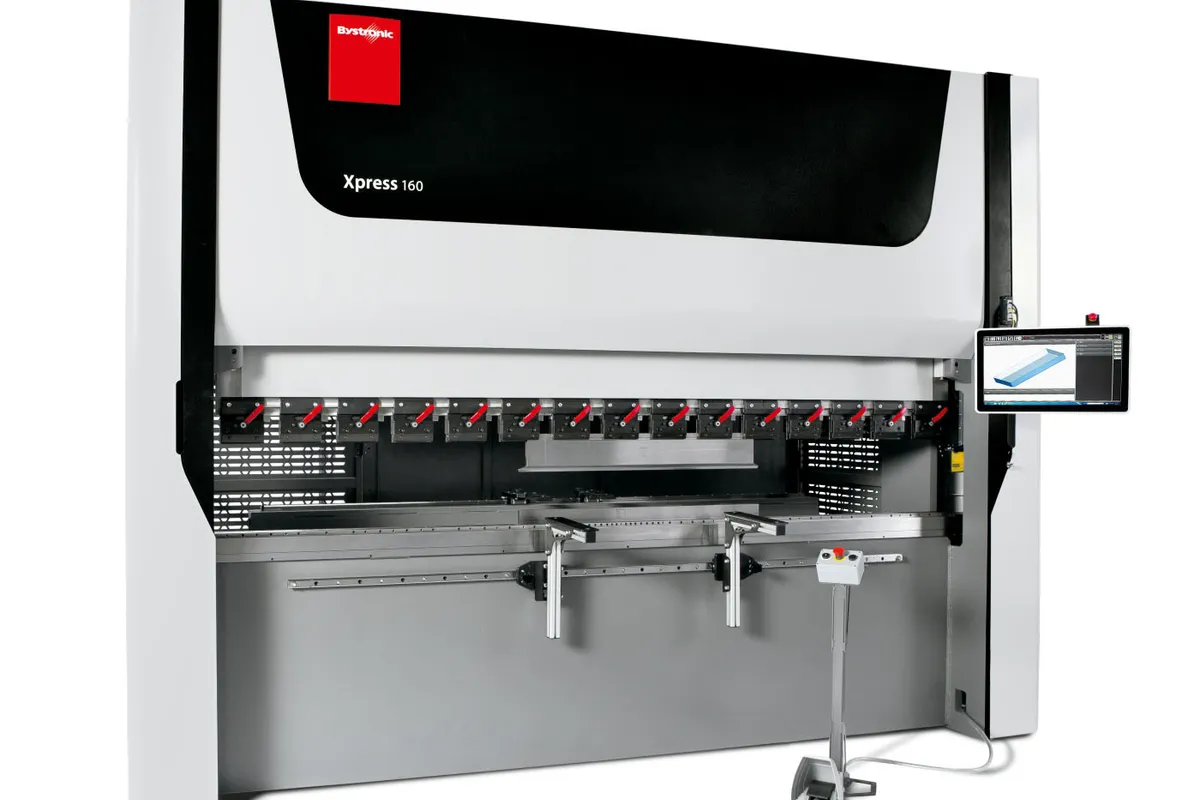
Bystronic Xpress 160
$80,000 - $130,000 (new); $50,000 - $90,000 (used 2018-2022) Updated 2026-03-11
01

Key Specifications

press capacity

1,600 kN / 160 metric tons (176 US tons)

bending length

3,100 mm (122 in)

stroke

250 mm (9.8 in)

open height

550 mm (21.7 in)

throat depth

400 mm (15.75 in)

approach speed

150 mm/s (354 ipm)

02

Overview

The Bystronic Xpress 160 is the top-of-the-line model in Bystronic's Xpress series -- their entry-level hydraulic press brake line designed for shops stepping into CNC bending for the first time or adding affordable capacity. At 160 metric tons (176 US tons) of press force and a 3,100 mm (122 in) bending length, it's got enough muscle and bed length to handle the bread-and-butter sheet metal work that most fab shops see daily. It won't replace a high-end Xpert Pro in a precision aerospace cell, but that's not the point -- the Xpress is about getting you bending parts quickly at an attractive price point backed by Swiss engineering.

The closed O-frame design is the structural foundation here, and it's a smart choice for a machine at this price class. The rigid frame minimizes deflection under load across the full bending length, which translates to more consistent bend angles without constantly fiddling with crowning adjustments. Approach speed tops out at 150 mm/s, pressing speed runs at 10 mm/s, and Y-axis positioning accuracy sits at 0.01 mm -- solid numbers for production bending work where you're running parts all day.

Bystronic equips the Xpress 160 with the ByVision Bending control, which is the same touchscreen interface used across their press brake lineup. It's intuitive enough that operators with minimal CNC bending experience can start running parts within hours, not days. The control integrates with BySoft Cell Control Bend software for offline programming and bend simulation, and it includes a comprehensive material database with pre-loaded bend allowance tables. For shops already running Bystronic lasers or other equipment, the software ecosystem ties everything together nicely.

The 4-axis backgauge system covers what most general fabrication work demands: X-axis travel of 500 mm (19.7 in) at 400 mm/s, R-axis travel of 100 mm (3.9 in) at 100 mm/s, and Z-axis travel of 2,300 mm (90.6 in) at 600 mm/s. That Z-axis range is generous for a machine in this class and lets you handle wider parts without repositioning. The modular design means you can configure different tool clamping systems and backgauge options to match your specific workflow.

Machine weight comes in at approximately 11,500 kg (25,353 lb) with overall dimensions of roughly 3,910 mm (154 in) long x 1,880 mm (74 in) wide x 2,718 mm (107 in) tall. Power requirement is 480V, 3-phase, 60 Hz with an 18.5 kW main motor and 30 kW total connected load. Hydraulic drive keeps things simple and proven -- no servo-electric complexity to maintain.

New Xpress 160 machines typically run $80,000-$130,000 depending on tooling package, backgauge configuration, and regional pricing. That positions it well below the Bystronic Xpert series ($150,000-$250,000+) and significantly under premium competitors like the Amada HG-1003 ($180,000-$250,000). Used Xpress units from 2018-2022 trade for $50,000-$90,000 depending on hours and condition.

Direct competitors include the Amada HG-1003 and HG-2204 (higher-end), Trumpf TruBend 5170 and TruBend 7036 (different tonnage classes), and various offerings from LVD and Ermaksan. The Xpress 160's edge is the combination of Bystronic's build quality and software ecosystem at an entry-level price point -- you're getting a Swiss-engineered machine without the premium price tag. Specs sourced from Bystronic published technical data, The Equipment Hub listings, and The Fabricator Press Brake Buyers' Guide.

03

Full Specifications

Parameter Value
Press Capacity 1,600 kN / 160 metric tons (176 US tons)
Bending Length 3,100 mm (122 in)
Stroke 250 mm (9.8 in)
Open Height 550 mm (21.7 in)
Throat Depth 400 mm (15.75 in)
Approach Speed 150 mm/s (354 ipm)
Pressing Speed 10 mm/s (24 ipm)
Y Axis Accuracy ±0.01 mm (±0.0004 in)
Back Gauge Axes 4-axis (X, R, Z1, Z2)
X Axis Travel 500 mm (19.7 in) at 400 mm/s
R Axis Travel 100 mm (3.9 in) at 100 mm/s
Z Axis Travel 2,300 mm (90.6 in) at 600 mm/s
CNC Control ByVision Bending (touchscreen)
Drive System Hydraulic
Frame Design Closed O-frame
Main Motor Power 18.5 kW (24.8 hp)
Total Connected Load 30 kW
Power Requirement 480V, 3-phase, 60 Hz
Machine Weight ~11,500 kg (25,353 lb)
Machine Length 3,910 mm (154 in)
Machine Width 1,880 mm (74 in)
Machine Height 2,718 mm (107 in)

Specifications sourced from bystronic.com — verified 2026-03-28

04

Strengths & Limitations

Strengths

  • Entry-level pricing ($80K-$130K new) gives you a Swiss-engineered Bystronic press brake at roughly half the cost of premium competitors like Amada HG or Trumpf TruBend series
  • Closed O-frame design delivers strong rigidity across the full 3,100 mm bending length, keeping bend consistency tight without constant crowning adjustments
  • ByVision Bending touchscreen control is genuinely intuitive -- new operators get productive fast, and offline programming via BySoft Cell Control Bend keeps the machine running while you prep the next job
  • Modular backgauge and tool clamping systems let you configure the machine to your specific workflow without paying for features you don't need
  • Generous Z-axis backgauge travel of 2,300 mm handles wide parts that would require repositioning on competing entry-level machines
  • Fits into existing Bystronic ecosystems seamlessly -- shops already running Bystronic lasers benefit from shared software platforms and a single service relationship
  • Compact footprint relative to tonnage class makes it practical for shops with limited floor space looking to add bending capacity

Limitations

  • Y-axis accuracy of ±0.01 mm is adequate for general fabrication but falls short of the ±0.001 mm repeatability offered by premium press brakes like the Amada HG series -- tight-tolerance aerospace or medical work may need more precision
  • No automatic tool changer option available -- shops running high-mix work with frequent tool changes will still face manual setup time that higher-end machines can eliminate
  • Pressing speed of 10 mm/s is on the slower side for high-volume production runs where cycle time drives profitability
  • Hydraulic drive system consumes more energy than servo-hydraulic or servo-electric alternatives that only engage during the actual bend stroke
  • Bystronic's dealer and service network in North America is thinner than Amada's or Trumpf's, which can mean longer wait times for service calls depending on your location
05

Best For

General fabrication shops adding their first CNC press brake who want proven technology without the premium price tag of a top-tier machine Small to mid-size job shops running mixed sheet metal work in mild steel, stainless, and aluminum where ±0.01 mm accuracy meets production requirements Shops already running Bystronic laser cutting systems that want a unified software ecosystem and single vendor relationship for service and support Contract manufacturers looking for affordable additional bending capacity to handle overflow work or second-shift production Fabricators processing standard gauge sheet metal up to 10 feet wide who need reliable hydraulic bending without the complexity and cost of servo-electric systems Growing businesses that want a solid entry point with room to scale -- the Xpress gets you started, and Bystronic's Xpert line provides a clear upgrade path when volumes and tolerances demand more
06

Frequently Asked Questions

01 What does a new Bystronic Xpress 160 cost?

A new Bystronic Xpress 160 typically runs $80,000-$130,000 depending on the tooling package, backgauge configuration, and regional dealer pricing. That makes it one of the more affordable options from a major European manufacturer. Used Xpress units from 2018-2022 trade for $50,000-$90,000 depending on hours, tooling included, and overall condition. Tooling packages can add $10,000-$30,000 to the base price depending on the variety of punches and dies you need.

02 How does the Bystronic Xpress 160 compare to the Amada HG-1003?

The Amada HG-1003 is a step up in precision and capability. It offers ±0.001 mm ram repeatability vs the Xpress 160's ±0.01 mm, plus an available Automatic Tool Changer (ATC) that the Xpress doesn't offer. However, the HG-1003 starts at $180,000-$250,000 -- roughly double the Xpress 160's price. If your work requires tight tolerances and frequent tool changes, the Amada justifies the premium. For general fabrication where ±0.01 mm accuracy is sufficient, the Xpress 160 delivers strong value at a lower investment.

03 What control system does the Xpress 160 use?

The Xpress 160 runs Bystronic's ByVision Bending control -- a touchscreen interface shared across their press brake lineup. It handles part programming, bend sequence calculation, and machine operation from a single panel. The control integrates with BySoft Cell Control Bend software for offline programming and bend simulation, so you can prep jobs at a desk while the machine runs production. It includes a built-in material database with bend allowance tables for common materials and thicknesses.

04 What tonnage and bending length does the Xpress 160 handle?

The Xpress 160 delivers 1,600 kN of press force, which works out to 160 metric tons or 176 US tons. The bending length is 3,100 mm (122 inches), covering standard 10-foot sheet sizes common in North American and European fabrication shops. That tonnage-to-length ratio handles most mild steel bending up to about 10mm (3/8 in) thick across the full bed, and heavier gauges over shorter lengths.

05 Is Bystronic service and support good in North America?

Bystronic has a solid reputation for build quality and their Swiss engineering heritage is well-regarded in the industry. Their North American service network has grown but remains smaller than Amada's or Trumpf's, which are the two largest press brake service organizations in the region. Forum users on Practical Machinist and Eng-Tips generally rate Bystronic machines highly and describe the company as 'really nice to deal with,' though some users have noted mixed experiences with service contracts. If you're in a major metro area, response times are typically good. More remote locations may see longer waits for on-site service.

06 What kind of maintenance does the Xpress 160 require?

As a conventional hydraulic press brake, the Xpress 160 requires standard hydraulic system maintenance: regular oil level checks, filter replacements, and periodic fluid changes. The hydraulic system runs continuously during operation, so oil temperature monitoring matters -- keep the machine in a climate-controlled environment if possible. Beyond hydraulics, you're looking at backgauge calibration checks, ram gibs inspection, and tooling maintenance. Bystronic recommends annual service inspections. The relatively simple hydraulic architecture means most maintenance can be handled by a competent in-house maintenance tech rather than requiring a factory-trained specialist.

07

Videos

Bystronic Xpert Pro Press Brake

Bystronic Xpert Pro Press Brake

On Point Solutions

Bystronic Xpress CNC Press Brake

Bystronic Xpress CNC Press Brake

On Point Solutions

Bystronic Xpress Press Brake Demo

Bystronic Xpress Press Brake Demo

On Point Solutions

How Xpert Pro Achieves Perfect Bend Angles in Sheet Metal with LAMS | Press Brakes | Bystronic

How Xpert Pro Achieves Perfect Bend Angles in Sheet Metal with LAMS | Press Brakes | Bystronic

Bystronic

Bystronic Xpert 40 + 80 Press Brake - Instruction manuals

Bystronic Xpert 40 + 80 Press Brake - Instruction manuals

On Point Solutions

08

Community Discussions

Practical Machinist

Fabrication: CNC Laser, Waterjet, Plasma, Welding |Bystronic...

Troubleshooting and problem-solving — Fabrication: CNC Laser, Waterjet, Plasma, Welding |Bystronic...

Practical Machinist

General | Tube benders and laser reviews?

Owner experience and review — Tube benders and laser reviews?

Practical Machinist

Fabrication: CNC Laser, Waterjet, Plasma, Welding | Nitrogen... | Forum

Community discussion — Fabrication: CNC Laser, Waterjet, Plasma, Welding | Nitrogen... | Forum

Practical Machinist

Fabrication: CNC Laser, Waterjet, Plasma, Welding | This is not your...

Community discussion — Fabrication: CNC Laser, Waterjet, Plasma, Welding | This is not your...

CNCZone

VMC Maintenance | Forum

Maintenance and service for this machine model.

CNCZone

VMC Maintenance | Forum

Maintenance and service for this machine model.

CNCZone

Threads and Threading | Forum

Community discussion about this machine.

CNCZone

07 Elect. Svc Alarms.indd | Forum

Maintenance and service — 07 Elect. Svc Alarms.indd | Forum

Reddit

Any Bystronic Laser cutting operators here? : r/Machinists

Community discussion — Any Bystronic Laser cutting operators here? :

Reddit

New Bystronic Laser Cutter installed and running at workWhy would this happen on a swiss type? : r/Machinists - RedditBenchtop drill presses with low runout? : r/Machinists - RedditAnyone have experience on a xpress 80? : r/Machinists - RedditLine boring questions : r/Machinists - RedditAny recommendations for cutters for stainless? : r/Machinists

Pricing and buying discussion — New Bystronic Laser Cutter installed and running at workWhy would this happen on a swiss type? : r/Machinists - RedditBenchtop drill presses with low runout? : r/Machinists - RedditAnyone have experience on a xpress 80? : r/Machinists - RedditLine boring questions : r

Reddit

Why would this happen on a swiss type? : r/Machinists - Reddit

Community discussion — Why would this happen on a swiss type? : r/Machinists - Reddit

Reddit

Benchtop drill presses with low runout? : r/Machinists - Reddit

Community discussion — Benchtop drill presses with low runout? : r/Machinists - Reddit

Links to community discussions. Summaries are editorial — visit the original thread for full context.

09

Comparisons

10

Related Machines