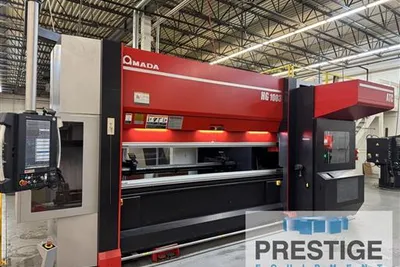
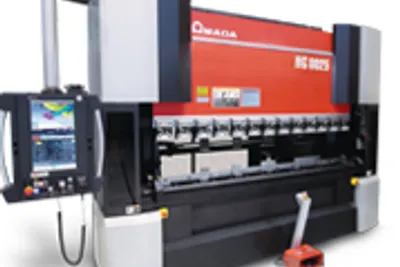
Amada HGB 50-20
Key Specifications
press force
bending length
distance between columns
open height
stroke
approach speed
Overview
The Amada HGB 50-20 is a compact CNC press brake in Amada's HGB series — a hydraulic bending platform designed for small to medium fabrication shops that need a capable, reliable CNC press brake without the cost or complexity of Amada's servo-electric HFE series or heavy-tonnage HG line. The designation 50-20 indicates 50 metric tons press force and 2,000 mm (78.7 in) bending length, placing the HGB 50-20 in the segment between compact 30-ton shop brakes and full-sized 80–100 ton production machines.
The HGB series is built around a conventional synchronized electro-hydraulic drive with direct-measuring linear encoders for Y-axis feedback. This is established technology that has proven reliable across hundreds of thousands of press brake installations worldwide. The advantage is cost predictability — hydraulic cylinders, pump assemblies, and hydraulic circuits have well-understood maintenance intervals and parts availability. Amada's hydraulic engineering is solid, and the HGB platform benefits from decades of iterative improvement on the fundamental architecture.
Y-axis accuracy on the HGB 50-20 is +/- 0.01 mm (0.0004 in) with linear encoder feedback, which is standard for this class of hydraulic press brake. Stroke is 100 mm with an open height of 380 mm (15 in), suitable for a wide range of standard sheet metal operations — box and pan work, angle bending, channel forming, and light structural shapes. Ram speed is 100 mm/s approach with a bending speed up to 10 mm/s and return at 100 mm/s.
The standard back gauge on the HGB 50-20 is a 4-axis CNC system (X, R, Z1, Z2) with a depth range of 500 mm and travel speed of 500 mm/s. For most small to medium shop applications — box parts, brackets, simple channels — 4-axis back gauge is entirely adequate. Complex multi-step parts with asymmetric flanges or deep box sections may benefit from a 6-axis upgrade, available as an option.
Amada equips the HGB 50-20 with its AMNC-PC or equivalent touchscreen control, which handles 2D programming with automatic bend sequence suggestion, tool layout display, and back gauge position calculation. The control interface is straightforward for experienced fabricators, and offline programming connects to Amada's SheetWorks or AP60 software for shops that want to program at a CAD workstation rather than at the machine.
Crowning on the HGB 50-20 is handled via manual adjustment or mechanical crowning wedge — CNC-controlled crowning is not standard at this capacity and price point, though it may be available as an option on specific regional configurations. For a 50-ton machine bending parts under 2 meters, manual crowning adjustment is generally adequate; the deflection at 50 tons is much less critical than at 150–320 tons.
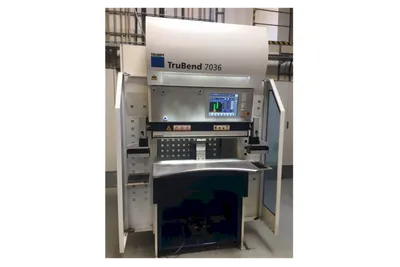
New HGB 50-20 machines typically run $90,000–$150,000 depending on back gauge configuration, tooling, and regional pricing. Used HGB series machines trade between $30,000 and $75,000. The HGB 50-20 competes directly with the TRUMPF TruBend 7036 (electric, premium), Bystronic Xpert 40/80 (hydraulic, European), and various domestic press brakes from Accurpress, Cincinnati, and Delem-equipped Asian-brand machines. The Amada brand carries a service and quality premium over the Asian-brand options; the HGB competes with Bystronic at similar price points. Specs are sourced from Amada published technical data, dealer listings, and equipment resellers.
Full Specifications
| Parameter | Value |
|---|---|
| Press Force | 500 kN / 50 metric tons (55 US tons) |
| Bending Length | 2,000 mm (78.7 in) |
| Distance Between Columns | 1,650 mm (65 in) |
| Open Height | 380 mm (15 in) |
| Stroke | 100 mm (3.9 in) |
| Approach Speed | 100 mm/s |
| Bending Speed | Up to 10 mm/s |
| Return Speed | 100 mm/s |
| Back Gauge Axes | 4-axis CNC (X, R, Z1, Z2) |
| Back Gauge Depth | 500 mm |
| Back Gauge Speed | 500 mm/s |
| Y Axis Accuracy | +/- 0.01 mm (0.0004 in) |
| CNC Control | Amada AMNC-PC (touchscreen) |
| Drive System | Synchronized electro-hydraulic |
| Crowning | Manual / mechanical wedge |
| Machine Weight | ~3,800 kg (8,378 lb) |
| E | e |
| Online Order Parts Tooling | Log-in & New Users Registration(opens in new window)Access the Amada Parts Portal for online parts and tooling orders |
| Subscribeview Excerpt | Highlighting AMADA's latest technologies and industry news — all in one convenient email.RegisterView Latest |
Specifications sourced from amada.com — verified 2026-03-28
Strengths & Limitations
Strengths
- Amada brand reliability and service network at a more accessible price point than the servo-electric HFE series
- 50-ton press force across 2,000 mm covers the vast majority of small shop sheet metal bending work
- Established hydraulic drive technology with well-understood maintenance intervals, parts availability, and repair costs
- AMNC-PC control with 2D bend sequence calculation and tool layout display streamlines setup for experienced operators
- 4-axis back gauge handles standard bracket, box, and channel work without additional cost
- Compact enough for smaller shops — machine weight of approximately 3,800 kg and moderate footprint fit standard shop floors without reinforcement
Limitations
- No CNC-controlled crowning as standard — manual crowning adjustment is adequate at 50 tons but requires operator attention on longer parts near the capacity limit
- Conventional hydraulic drive lacks the energy efficiency and zero-maintenance advantages of Amada's servo-electric HFE series
- 4-axis back gauge standard limits flexibility on complex parts; upgrading to 6-axis adds cost
- Y-axis accuracy of +/- 0.01 mm is standard for hydraulic press brakes but falls well short of the +/- 0.0001 mm offered by the HFE servo-electric platform
- At $90K–$150K, the HGB 50-20 competes with capable Asian-brand CNC brakes that offer similar specs at lower prices — the Amada premium requires valuing service network and brand reliability
Best For
Frequently Asked Questions
01
New HGB 50-20 machines typically run $90,000–$150,000 depending on back gauge configuration, tooling packages, and regional pricing. Base configurations with 4-axis back gauge and standard tooling are at the lower end. Adding tooling packages, back gauge upgrades, or optional angle measurement pushes pricing higher. Used HGB series machines in comparable capacity trade between $30,000 and $75,000 depending on hours, condition, and control generation.
02
The HFE series uses Amada's servo-electric ball screw drive for +/- 0.0001 mm Y-axis accuracy and zero hydraulic maintenance. The HGB 50-20 uses a conventional electro-hydraulic drive with +/- 0.01 mm accuracy — adequate for most fabrication work, but not in the same precision class. The HFE is substantially more expensive new. For shops where precision is critical (medical, aerospace, tight-tolerance electronics), the HFE's accuracy justifies the cost. For standard contract fabrication, the HGB delivers capable production results at a lower investment.
03
At the full 2,000 mm bending length, the HGB 50-20 handles mild steel up to approximately 4–5 mm depending on die opening and material grade. For stainless steel, multiply the mild steel capacity by approximately 0.6 (stainless requires more tonnage per unit thickness). Aluminum bends at roughly 1.5x the mild steel capacity at the same thickness. At shorter partial bending lengths, effective capacity increases proportionally — a 500 mm partial length can handle roughly 8–10 mm mild steel.
04
Yes. The HGB series uses Amada's standard precision tooling system, which is compatible across the HGB, HG, and HFE press brake lines. This means existing Amada tooling investments are transferable if you upgrade to a larger machine later. Third-party tooling in Amada-style (also compatible with Wilson and other brands' similar systems) can also be used, providing more sourcing flexibility than TRUMPF's proprietary tooling system.
05
The HGB 50-20 ships with Amada's AMNC-PC touchscreen control, which handles 2D programming with automatic bend sequence suggestion, tool layout display, and back gauge position calculation. It connects to Amada's offline programming software (SheetWorks, AP60) for shops that prefer to program at a workstation. The AMNC-PC is a capable, well-documented control with a straightforward interface for experienced press brake operators.
Videos

xJuliettex
Community Discussions
Troubleshooting and problem-solving — Help please . Amada APX 50-20 not initialising at start?
Options and configuration advice — Bending- and Punching Machines - Page 2 - CNCzone
Community discussion — Search Results - CNCzone.com- Largest Forums for CNC ...
Troubleshooting and problem-solving — Experienced operator tip - Amada Vipros issue - CNCzone
Links to community discussions. Summaries are editorial — visit the original thread for full context.