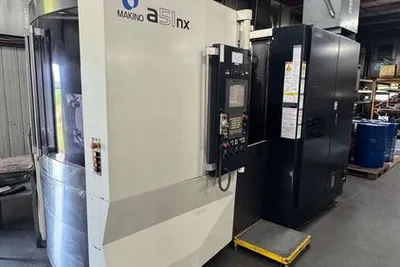
Tsugami FMA3H-V
Key Specifications
X Travel
Y Travel
Z Travel
Max Spindle
Spindle Taper
Tool Capacity
How much does the Tsugami FMA3H-V cost?
Estimated price range
Our best estimate for a horizontal machining centers (hmc) in this class — not a quote from Tsugami. Configuration moves it a long way.
Overview
The Tsugami FMA3H-V is the high-speed, large-magazine build of the FMA3 horizontal machining center: an 18,000 rpm (rated 14,000 rpm) 40-taper spindle and 121 tool pockets, on 300 × 300 mm (11.8 × 11.8 in) pallets with 360 mm (14.2 in) of X, 330 mm (13.0 in) of Y and 400 mm (15.7 in) of Z travel.
A magazine of 121 tools changes how a cell is run. The tooling for several part numbers can stay loaded at once, so a mix of small aluminium or die-cast housings can run back to back without stopping to set tools between jobs. The FMA3-V, with the same travels, holds 62.
The spindle rating is 18.5/26/30 kW. That is below the 22/26/37 kW of the FMA3-V, but the speed suits small end mills, drills and finishing passes in non-ferrous material, where the 10,000 rpm ceiling of the FMA3-V would hold back cutting speed. The taper is 7/24 No.40 with BBT40 shanks.
The rest of the listed table matches the FMA3-V: a B axis indexed in 1° steps for positioning, 24 m/min rapids and an 80 kg (176 lb) pallet rating. That load limit decides what fixtures are practical, so weigh them early. The FMA3H-V is also the bigger machine. It weighs 12,200 kg (26,896 lb), against 9,800 kg (21,605 lb) for the FMA3-V, and needs 4,737 × 2,730 × 2,768 mm (186 × 107 × 109 in) of floor and height.
Full Specifications
| Parameter | Value |
|---|---|
| Spindle Taper | 7/24 taper No.40 |
| Max Spindle Speed | 18,000 rpm (rated 14,000 rpm) |
| Spindle Motor Power | 18.5/26/30 kW |
| Pallet Size | 300 × 300 mm (11.8 × 11.8 in) |
| Max Pallet Load | 80 kg (176 lb) |
| Pallet Index | 1° (B axis, positioning) |
| X-Axis Travel | 360 mm (14.2 in) |
| Y-Axis Travel | 330 mm (13.0 in) |
| Z-Axis Travel | 400 mm (15.7 in) |
| Rapid Traverse Rate | 24 m/min |
| Tool Shank | BBT40 |
| Tool Capacity | 121 |
| Floor Space Required | 4,737 × 2,730 × 2,768 mm (186 × 107 × 109 in) |
| Machine Weight | 12,200 kg (26,896 lb) |
Specifications sourced from tsugami.co.jp — verified 2026-10-03
Strengths & Limitations
Strengths
- 121-tool magazine, against 62 on the FMA3-V, keeps tooling for several jobs loaded
- 18,000 rpm spindle (rated 14,000 rpm) for small tools and non-ferrous finishing
- 18.5/26/30 kW rating still leaves room for roughing in aluminium
- B axis indexes in 1° steps for multi-face work on each 300 × 300 mm pallet
Limitations
- Pallet load is limited to 80 kg (176 lb)
- Less spindle power than the 22/26/37 kW FMA3-V for steel and cast iron
- Largest FMA3 footprint at 4,737 × 2,730 mm (186 × 107 in) and 12,200 kg (26,896 lb)
- The B axis is listed for positioning only, not simultaneous machining
Best For
Frequently Asked Questions
01
Speed and tool count. The FMA3H-V spindle runs to 18,000 rpm (rated 14,000 rpm) and the magazine holds 121 tools. The FMA3-V runs to 10,000 rpm (rated 8,000 rpm) with 62 tools but has the stronger 22/26/37 kW spindle against 18.5/26/30 kW. Travels and pallets are the same.
02
Small pallets usually mean many different small parts. With 121 pockets, the tools for several part numbers stay in the machine, so changing jobs means changing the fixture and program rather than re-setting tools. That is where the FMA3H-V earns its larger footprint.
03
It weighs 12,200 kg (26,896 lb) and measures 4,737 × 2,730 × 2,768 mm (186 × 107 × 109 in). Check the floor and the delivery route against those figures, and allow access to the tool magazine for loading 121 tools.
04
The spindle is a 7/24 taper No.40 taking BBT40 shanks. Each 300 × 300 mm (11.8 × 11.8 in) pallet is rated for 80 kg (176 lb), including fixture and parts, and the B axis indexes in 1° steps for positioning.
More from Tsugami


Other Horizontal Machining Centers (HMC)
Makino a91nx
Kiwa KH-4500kai

DN Solutions NHC 5000
Makino J6
DMG Mori NHX 5000 4th Generation