Industrial CNC Machine Directory

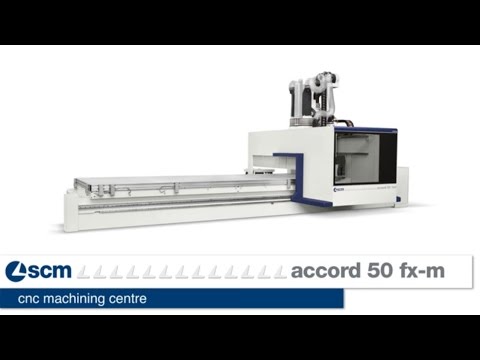
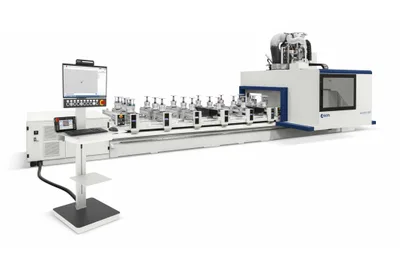
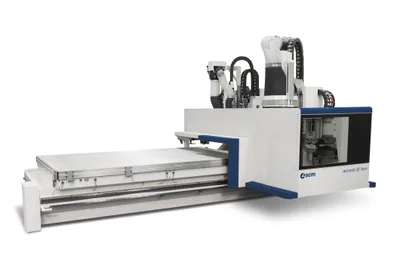
SCM Accord 50 FX

$150,000 - $320,000 Updated 2026-03-17
01

Key Specifications

Max Spindle

24,000 RPM

Spindle Power

12.6 kW (16.9 HP)

work area x

Up to 4,300 mm (169 in)

work area y

1,870 mm (73.6 in)

work area z

350 mm (13.8 in)

axes

5-axis simultaneous (X, Y, Z, B-tilt, C-rotation)

02

Overview

The SCM Accord 50 FX is a five-axis CNC machining center from SCM Group of Rimini, Italy, designed for advanced panel processing, solid wood machining, and complex three-dimensional routing operations that require full simultaneous five-axis interpolation. The Accord FX series represents SCM's premium machining center lineup — above the standard Accord series in capability, targeting furniture manufacturers, architectural millwork producers, and contract CNC service shops that require the most versatile CNC machining platform in SCM's range.

The Accord 50 FX features a horizontal electrospindle with continuous 360-degree C-axis rotation and tilt B-axis, enabling the machine to approach workpiece surfaces from any direction without repositioning. This full five-axis capability enables operations that are not possible on three-axis machines: undercuts, compound-angle profiles, curved sculptural surfaces, complex frame joinery with angled mortises and tenons, and 3D relief carving. The machine's A-axis tilting spindle can machine horizontal surfaces, vertical surfaces, and any angle between in a single continuous program cycle.

SCM's Maestro Watch control system (the advanced variant of Maestro HMI) supports five-axis simultaneous interpolation with tool center point (TCP) control — maintaining constant surface speed and chip load regardless of spindle tilt angle. This five-axis CAM programming capability is handled through integration with Alphacam, PowerMILL, or other five-axis capable CAM systems, as SCM's native xCAM is primarily suited for 3+2 positioning operations.

The Accord 50 FX serves a premium segment: custom furniture manufacturers producing artistic and high-design furniture with complex curved forms; architectural millwork shops producing curved moldings, custom column capitals, and sculpted panel details; religious furniture and church furniture manufacturers with elaborate carved details; and CNC service bureaus requiring the broadest capability range to serve diverse customer demands. It competes with HOMAG's five-axis configured machining centers and the Biesse Rover B series five-axis variants. SCM pricing for the Accord 50 FX typically runs $150,000 to $320,000 depending on table format, spindle specification, and ATC configuration.

03

Full Specifications

Parameter Value
Work Area X Up to 4,300 mm (169 in)
Work Area Y 1,870 mm (73.6 in)
Work Area Z 350 mm (13.8 in)
Spindle Motor Power 12.6 kW (16.9 HP)
Max Spindle Speed 24,000 RPM
Axes 5-axis simultaneous (X, Y, Z, B-tilt, C-rotation)
Tool Changer Up to 24 positions (automatic tool changer)
Feed Rate Up to 90 m/min rapid
CNC Control SCM Maestro Watch (five-axis TCP programming)
Machine Weight 7,200 kg (15,873 lb) approximate
X Y Z Axes Dimensions mm
X Y Z Axes Max Speed m/min
5 Axes Electrospindle Motor Power kW
5 Axes Electrospindle Rotation Speed rpm
Tool Store On Machining Head positions
Rear Tool Store positions
Side Tool Store positions
Vertical And Horizontal Spindles n.
Rotation Speed rpm

Specifications sourced from scmgroup.com — verified 2026-03-28

04

Strengths & Limitations

Strengths

  • Full simultaneous five-axis interpolation with continuous C-axis rotation enables undercuts, compound sculpted surfaces, and complex joinery in a single setup that three-axis machines cannot achieve
  • 350 mm Z-axis stroke provides clearance for thick solid wood blanks, stacked panel assemblies, and fixtures that elevate workpieces for edge access
  • SCM's premium Maestro Watch control supports tool center point (TCP) programming for consistent surface quality across all spindle tilt angles
  • Large 4,300 mm X travel handles long solid wood components, large furniture subassemblies, and multiple smaller parts in a single production run
  • SCM Group's global distribution network and extensive application engineering team provide strong support for complex five-axis programming and tooling setup

Limitations

  • Five-axis programming requires CAM software expertise that is substantially more complex than three-axis panel routing — operator training requirements and software investment are higher
  • Premium pricing ($150K–$320K) positions this above the majority of furniture production applications — most furniture manufacturing does not require true five-axis simultaneous machining
  • Five-axis machine maintenance and calibration complexity is higher than three-axis machines — requiring more skilled maintenance personnel and longer scheduled maintenance windows
05

Best For

Custom furniture designers producing high-design pieces with compound curves, sculpted surfaces, and complex three-dimensional forms requiring true five-axis simultaneous machining Architectural millwork producers making curved moldings, decorative column capitals, custom cornice profiles, and sculptural architectural elements from solid wood Religious and liturgical furniture manufacturers producing carved altar pieces, pulpits, choir stalls, and decorative woodwork with complex relief and sculpted detail CNC service bureaus and contract machining shops requiring the widest capability range to serve diverse customers with complex one-off and short-run wood machining requirements
06

Frequently Asked Questions

01 What is the difference between 3+2 positioning and true simultaneous five-axis machining?

In 3+2 positioning (also called indexed five-axis), the machine tilts and rotates the spindle to a fixed angle, locks those axes, then performs the cutting motion using only X, Y, and Z. This allows angled approach to workpiece surfaces but the spindle does not tilt during cutting. In true simultaneous five-axis machining, all five axes move at the same time during cutting — the spindle tilts and rotates continuously as it traces a 3D surface. Simultaneous five-axis is required for: machining complex curved surfaces without visible facets; maintaining constant surface speed on undulating surfaces; machining undercuts where the tool must continuously change angle to follow the surface geometry; and high-speed five-axis finishing where the tool constantly adjusts angle to optimize chip load. The Accord 50 FX supports both modes — 3+2 for most furniture applications, simultaneous for sculptural and complex curved work.

02 What CAM software works with the Accord 50 FX for five-axis programming?

For true five-axis simultaneous programming on the Accord 50 FX, the standard industry options are: Alphacam (preferred for woodworking, SCM offers a certified post-processor); PowerMILL (strongest for complex 3D sculptural machining, common in high-end custom work); Mastercam (widely trained operators); and WorkNC (strong for sculptural surfaces). SCM's native xCAM handles 3+2 positioned operations and standard routing/drilling programs — it is not suited for complex simultaneous five-axis toolpath generation. Most Accord 50 FX users run a two-software approach: xCAM or Maestro's built-in programming for standard furniture operations, and a dedicated five-axis CAM package (Alphacam or PowerMILL) for complex sculptural and joinery work. Post-processors are available from both SCM and the CAM software vendors.

03 What materials and workpiece types benefit most from five-axis machining?

Five-axis simultaneous machining delivers the most benefit in: solid wood sculptural work (chair backs, cabriole legs, carved panels, column details — surfaces that curve in multiple directions); complex solid wood joinery with angled mortises, compound tenons, and angled bridle joints; MDF and solid surface 3D relief panels (decorative wall panels, carved cabinet door panels); thick composite sandwich panels requiring edge machining at various angles; acrylic and polycarbonate sculptural forms; and instrument bodies and other precision curved wood objects. For standard flat panel furniture (cabinets, shelves, drawer fronts), three-axis machining is fully sufficient and more cost-effective. Five-axis justification requires a production mix that regularly includes genuinely three-dimensional work.

04 How does the Accord 50 FX's pod-and-rail workholding handle complex three-dimensional workpieces?

For three-dimensional workpieces on the Accord 50 FX, standard pod-and-rail suction cups are supplemented with custom fixtures, cast resin holding jigs, and mechanical clamps. Solid wood blanks for sculptural work are typically clamped mechanically using the machine's T-slot table and step clamps, since vacuum cups cannot seal reliably on rough or irregular surfaces. For production quantities of the same 3D form, custom vacuum fixtures are cast from epoxy resin in the shape of the finished part's underside, providing full-surface vacuum contact. SCM's applications team assists in fixture design for complex workholding challenges. Five-axis accessibility means the machine can approach from multiple angles and workpieces typically need less repositioning than equivalent operations on a three-axis machine.

05 How does the Accord 50 FX compare to the Accord 35 FX and Accord 30 FX?

The Accord FX series is SCM's five-axis platform, with the numbers indicating table format and spindle specification — the 50 FX is the largest standard model, the 35 FX is mid-range, and the 30 FX is the compact entry to the FX series. The 50 FX has the longest X-axis travel (up to 4,300 mm vs. shorter on the 35 FX and 30 FX), higher spindle power (12.6 kW vs. lower on smaller models), and larger ATC capacity. All three share the same five-axis spindle concept and Maestro Watch control. The choice between models depends on the maximum workpiece length in the production mix: shops primarily processing up to 2,500 mm parts can use the 30 FX efficiently; shops needing to process longer furniture elements, full-length solid wood components, or large architectural panels require the 50 FX's travel range.

07

Videos

SCM Accord 50 FX-M

SCM Accord 50 FX-M

SCM Woodworking Technology

SCM Accord 50 FX-M

SCM Accord 50 FX-M

Rogiers

SCM ACCORD 50 FX (Höchsmann Klipphausen)

SCM ACCORD 50 FX (Höchsmann Klipphausen)

Höchsmann GmbH - Technology for Wood
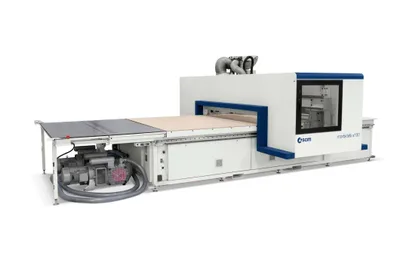
MATIC - SCM Automatic Worktable

MATIC - SCM Automatic Worktable

SCM Woodworking Technology

Accord 25fx

Accord 25fx

Jan Plánička

08

Community Discussions

09

Related Machines