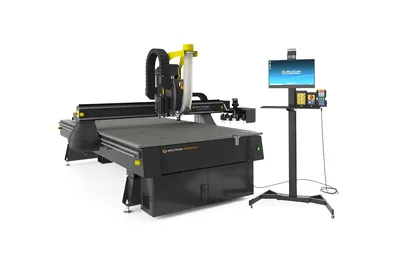
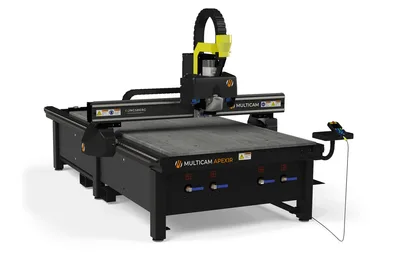
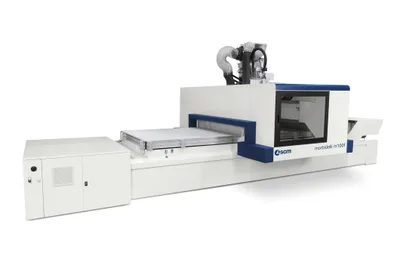
MultiCam 7000 Series
This model was not found in MultiCam's current lineup when we checked on 2026-10-03 . It may be a superseded or older model; the specifications below are as we last recorded them.
Key Specifications
Max Spindle
Spindle Power
work area x
work area y
work area z
feed rate max
How much does the MultiCam 7000 Series cost?
Estimated price range
Our best estimate for a cnc router in this class — not a quote from MultiCam. Configuration moves it a long way.
Overview
The MultiCam 7000 Series is a CNC router listed with X travel from 61 in (1,550 mm) to 122 in (3,100 mm), a standard Y of 121 in (3,073 mm) and a 12–24 hp (8.9–17.9 kW) spindle running to 24,000 RPM. It is not in MultiCam's current lineup, and the listed figures have not been confirmed against a MultiCam document. They work best as a checklist when inspecting a used machine.
Gantry width is the main variable. The narrow configuration has 61 in (1,550 mm) of X and the wide one 122 in (3,100 mm), double the span, and an extended bed is listed as available beyond the standard Y. Z travel is 10 in (254 mm) in every case. Feed rate peaks at 1,800 in/min (45.7 m/min), and the control is the MultiCam e-Panel Pro.
The 7000 sits below the 8000 Series, which is listed with 20–30 hp (14.9–22.4 kW) and 2,000 in/min (50.8 m/min). It is also the lighter of the two at approx. 5,500–7,000 lb (2,495–3,175 kg). No tool changer, hold-down or accuracy figure is listed, so ask what the individual machine has.
Full Specifications
| Parameter | Value |
|---|---|
| Work Area X | 61 in (1,550 mm) to 122 in (3,100 mm) depending on config |
| Work Area Y | 121 in (3,073 mm) standard; extended bed available |
| Work Area Z | 10 in (254 mm) |
| Spindle Motor Power | 12–24 hp (8.9–17.9 kW) |
| Max Spindle Speed | 24,000 RPM |
| Feed Rate Max | 1,800 in/min (45.7 m/min) |
| CNC Control | MultiCam e-Panel Pro |
| Machine Weight | Approx. 5,500–7,000 lb (2,495–3,175 kg) |
Specifications compiled from manufacturer literature and industry references. Not independently verified against a published spec sheet — confirm with the manufacturer or an authorised dealer before making a purchasing decision.
Strengths & Limitations
Strengths
- X travel listed from 61 in (1,550 mm) up to 122 in (3,100 mm)
- 12–24 hp (8.9–17.9 kW) spindle range at 24,000 RPM
- Feed rate up to 1,800 in/min (45.7 m/min)
Limitations
- Not in MultiCam's current lineup; the listed figures are unconfirmed
- Z travel is 10 in (254 mm) on every configuration
- No tool changer, hold-down or accuracy figure is listed
Best For
Frequently Asked Questions
01
No. The 7000 Series is not in MultiCam's current lineup and appears to be an older model. The listed figures are unconfirmed, so verify travels, spindle and control on the machine itself.
02
X is listed from 61 in (1,550 mm) to 122 in (3,100 mm) depending on configuration. Y is 121 in (3,073 mm) as standard, with an extended bed available, and Z is 10 in (254 mm).
03
The 7000 is listed with a 12–24 hp (8.9–17.9 kW) spindle and 1,800 in/min (45.7 m/min). The 8000 Series is listed with 20–30 hp (14.9–22.4 kW) and 2,000 in/min (50.8 m/min). Both are listed at 24,000 RPM and with the e-Panel Pro control.
Videos

MultiCam Middle East

Steve Gordon

Jim Unsworth

Burak TULUK
Community Discussions
Troubleshooting and problem-solving
Links to community discussions. Summaries are editorial — visit the original thread for full context.