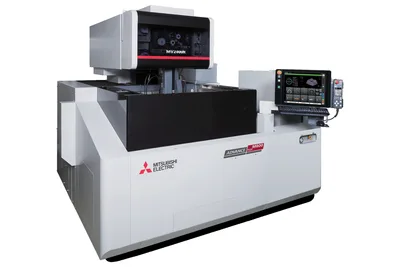
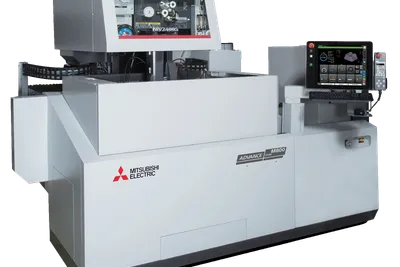
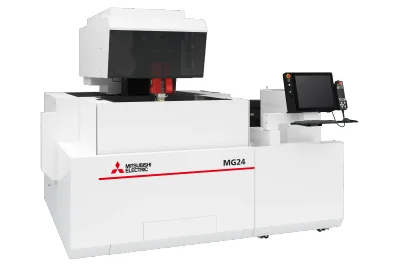
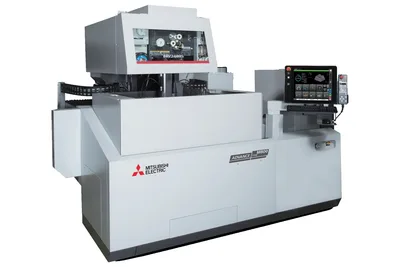
Mitsubishi Electric FA30 Advance
This model was not found in Mitsubishi Electric's current lineup when we checked on 2026-10-03 (lineup page). It may be a superseded or older model; the specifications below are as we last recorded them.
Key Specifications
X Travel
Y Travel
Z Travel
Table Size
x y travel
z travel
How much does the Mitsubishi Electric FA30 Advance cost?
Estimated price range
Our best estimate for a wire edm in this class — not a quote from Mitsubishi Electric. Configuration moves it a long way.
Overview
The Mitsubishi Electric FA30 Advance is a large-format wire EDM. By the listed figures it accepts workpieces up to 1050 x 750 x 400 mm on a 34.4 x 43.3 in table and tilts the wire up to ±30° over a 100 mm height. Mitsubishi Electric no longer shows it in the current lineup, so what follows is meant for someone weighing up a used machine.
The cutting data in the table comes with its test conditions, which is helpful. Maximum cutting speed is 450 mm²/min in 50 mm steel with 0.25 mm wire, and surface finish is Ra 0.1 µm after final skim passes on hardened steel. A seller's demonstration can be held against the same conditions.
Wire from 0.1 to 0.3 mm is supported. Automatic threading uses a water jet with electrical discharge assist and needs a start hole of 0.4 mm or more. U and V travel is ±60 mm (±2.4 in), and that offset is what produces the ±30° taper at 100 mm. On thicker sections the available angle will be smaller, and the table does not say by how much.
The control is listed as a Mitsubishi V500 CNC with Expert System and ADAP technology. The dielectric is deionized water with a built-in filtration and deionization unit, and the electrical supply is 200 V three-phase at 50/60 Hz. As a size reference, the MV4800S has 31.5 in (800 mm) of X travel and 23.6 in (600 mm) of Y.
Full Specifications
| Parameter | Value |
|---|---|
| X Y Travel | 600 x 400 mm (23.6 x 15.7 in) |
| Z Travel | 400 mm (15.7 in) |
| U V Travel | ±60 mm (±2.4 in) |
| Max Workpiece Dimensions | 1050 x 750 x 400 mm |
| Max Workpiece Weight | 600 kg (1,323 lb) |
| Wire Diameter Range | 0.1 – 0.3 mm |
| Max Cutting Speed | 450 mm²/min (in 50 mm steel with 0.25 mm wire) |
| Surface Finish | Ra 0.1 µm (final skim passes on hardened steel) |
| Max Taper Angle | ±30° over 100 mm height |
| Auto Wire Threading | Yes — water-jet + electrical discharge assist, ≥0.4 mm start hole |
| CNC Control | Mitsubishi V500 CNC with Expert System and ADAP technology |
| Dielectric | Deionized water with built-in filtration/deionization unit |
| Power Supply | 200V, 3-phase, 50/60 Hz |
| X-Axis Travel | 29.5" |
| Y-Axis Travel | 19.6" |
| Z-Axis Travel | 26.5" |
| Table Size | 34.4" x 43.3" |
| Table Load Max | 6600 Lbs. |
Specifications sourced from machinio.com — verified 2026-03-28
Strengths & Limitations
Strengths
- Maximum workpiece of 1050 x 750 x 400 mm in the listed figures
- Taper of ±30° over 100 mm height, from ±60 mm (±2.4 in) of U and V travel
- Cutting speed of 450 mm²/min, stated for 50 mm steel with 0.25 mm wire
- Surface finish of Ra 0.1 µm after final skim passes on hardened steel
- Automatic threading with water jet and electrical discharge assist through start holes from 0.4 mm
Limitations
- The listed figures give two different sets of axis travels and two different load limits, so strokes and table load must be confirmed on the machine
- The ±30° taper is stated over 100 mm height only; no figure is given for thicker work
- No machine weight, footprint or tank capacity is listed, which leaves the installation to be planned from the machine's own documents
Best For
Frequently Asked Questions
01
The listed maximum workpiece dimensions are 1050 x 750 x 400 mm, and the table size is given as 34.4 x 43.3 in. The table of figures disagrees with itself on axis travel and on weight capacity, so read the strokes and the load rating from the machine's nameplate and manual.
02
The maximum taper angle is ±30° over 100 mm height. U and V travel is ±60 mm (±2.4 in). Since the taper depends on how far the upper guide can offset, the angle available on a thicker part is lower than the listed figure; the table gives no value for other heights.
03
Maximum cutting speed is listed as 450 mm²/min in 50 mm steel with 0.25 mm wire. Surface finish is listed as Ra 0.1 µm after final skim passes on hardened steel. The speed is a roughing figure and the finish a multi-pass figure, so the two are not achieved together.
04
The control is listed as a Mitsubishi V500 CNC with Expert System and ADAP technology. Automatic wire threading uses a water jet plus electrical discharge assist and works through a start hole of 0.4 mm or larger. The wire diameter range is 0.1 – 0.3 mm.
Videos

Surplex
Community Discussions
Links to community discussions. Summaries are editorial — visit the original thread for full context.