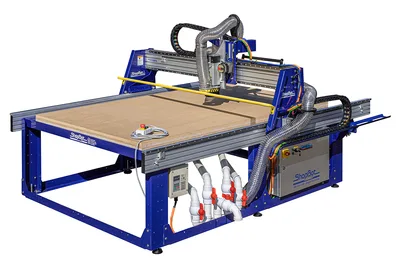
HOMAG BMG 300
This model was not found in HOMAG's current lineup when we checked on 2026-10-03 . It may be a superseded or older model; the specifications below are as we last recorded them.
Key Specifications
Max Spindle
Spindle Power
work area x
work area y
work area z
axes
How much does the HOMAG BMG 300 cost?
Estimated price range
Our best estimate for a cnc router in this class — not a quote from HOMAG. Configuration moves it a long way.
Overview
The HOMAG BMG 300 is a 5-axis woodworking CNC machining center, listed with a work area of up to 4,900 mm (193 in) in X, 1,300 mm (51 in) in Y and 300 mm (11.8 in) in Z. It is not in HOMAG's current lineup and may be an older model, so this page mostly serves someone weighing up a used machine. The listed figures are unverified and should be compared with the nameplate and the machine's own documentation.
The proportions say a lot. X is nearly four times Y, which suits long, narrow workpieces, or two shorter parts clamped one after the other along the bed so that one can be loaded while the other is cut. Z is the dimension to watch. Its 300 mm (11.8 in) has to cover the part, its clamping and the tool, and on a head with A/C rotation the tool swings outward as it tilts, so tall parts lose clearance quickly.
The spindle is listed at 11 kW (15 HP) and 24,000 RPM, a router combination meant for small-diameter tooling at high speed. The automatic tool changer has up to 20 positions and rapids are listed at up to 80 m/min. Control is HOMAG powerTouch with woodWOP programming, and the weight is approximately 6,500 kg (14,330 lb).
Full Specifications
| Parameter | Value |
|---|---|
| Work Area X | Up to 4,900 mm (193 in) |
| Work Area Y | 1,300 mm (51 in) |
| Work Area Z | 300 mm (11.8 in) |
| Spindle Motor Power | 11 kW (15 HP) |
| Max Spindle Speed | 24,000 RPM |
| Axes | 5-axis (X, Y, Z + A/C rotation) |
| Tool Changer | Up to 20 positions (automatic tool changer) |
| Feed Rate | Up to 80 m/min rapid |
| CNC Control | HOMAG powerTouch (woodWOP programming) |
| Machine Weight | 6,500 kg (14,330 lb) approximate |
Specifications compiled from manufacturer literature and industry references. Not independently verified against a published spec sheet — confirm with the manufacturer or an authorised dealer before making a purchasing decision.
Strengths & Limitations
Strengths
- Listed work area of up to 4,900 mm (193 in) in X by 1,300 mm (51 in) in Y, long enough for two setups along the bed
- A/C rotation on top of X, Y and Z, for angled cuts and bores without re-clamping the part
- 24,000 RPM spindle rated 11 kW (15 HP), matched to small-diameter router tooling
- Automatic tool changer with up to 20 positions, and rapids listed at up to 80 m/min
Limitations
- Not in HOMAG's current lineup, and the listed figures are unverified, so each one needs checking on the actual machine
- Z is 300 mm (11.8 in), which must cover part height, clamping and tool length together
- The table gives 11 kW (15 HP) and 24,000 RPM but no torque figure, so heavy cuts with large tools are an open question
- Y stops at 1,300 mm (51 in), so wider panels cannot be machined in one setup
Best For
Frequently Asked Questions
01
It is not in HOMAG's current lineup and may be an older model. That makes it a used-machine purchase. The listed figures are unverified, so compare them with the nameplate and the documentation that comes with the machine before relying on any of them.
02
The listed figures are up to 4,900 mm (193 in) in X, 1,300 mm (51 in) in Y and 300 mm (11.8 in) in Z. The X figure is given as a maximum, which suggests more than one bed length existed, so measure the machine on offer instead of assuming the longest.
03
The spindle is listed at 11 kW (15 HP) with a top speed of 24,000 RPM, and the automatic tool changer has up to 20 positions. The head is 5-axis, described as X, Y and Z plus A/C rotation. On a used machine, count the tool places actually fitted.
04
The control row lists HOMAG powerTouch with woodWOP programming. When inspecting a used machine, note which software release is installed and test whether woodWOP programs from the other machines in the shop load and run without changes.
Videos

NOINER
More from HOMAG
Other CNC Routers
Onsrud 181G 5-Axis
Quintax R4
MultiCam 6000 Series CNC Router
Masterwood Project 300 CNC Machining Center