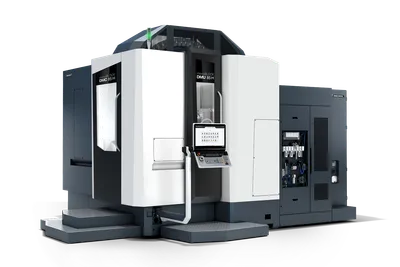
Heller MCP H 400
This model was not found in Gebr. Heller's current lineup when we checked on 2026-10-03 . It may be a superseded or older model; the specifications below are as we last recorded them.
Key Specifications
X Travel
Y Travel
Z Travel
Max Spindle
Spindle Taper
Tool Capacity
How much does the Heller MCP H 400 cost?
Estimated price range
Our best estimate for a horizontal machining centers (hmc) in this class — not a quote from Gebr. Heller. Configuration moves it a long way.
Overview
A pallet pool is the centre of the Heller MCP H 400 listing: a horizontal machining center on 400 x 400 mm pallets whose pool is described as scalable from 6 to 100+ pallets, run by a Siemens Sinumerik 840D sl control with Heller FMS software. Heller's website does not carry this model, so the page rests on the listed figures alone, and each one deserves a check against the documents of the system being offered.
Each machine works within 560 mm (22 in) of X, 560 mm (22 in) of Y and 620 mm (24.4 in) of Z, and the table load capacity is 500 kg (1,102 lb). Those are small-machine figures. Part and fixture together have to stay inside 500 kg (1,102 lb), and a 400 x 400 mm pallet leaves little room for wide tombstones.
The spindle is listed at 37 kW (49.6 hp) with an HSK-A63 taper and 8,000 RPM, with 15,000 RPM as an option. The choice matters: 8,000 RPM points to iron and steel, while aluminium with small tools wants the optional speed. No torque figure is listed for either. Rapids are 60 m/min (2,362 ipm) and positioning accuracy is listed as 0.004 mm (ISO 230-2).
Tool storage is 80 per machine, and a centralized tool pool is listed as an option. With many pallets queued, the number of different jobs that can run unattended is set by tools as much as by pallets, so count sister tools and special cutters against those 80 places before sizing the pool.
Full Specifications
| Parameter | Value |
|---|---|
| Pallet Size | 400 x 400 mm |
| Table Load Capacity | 500 kg (1,102 lb) |
| X-Axis Travel | 560 mm (22 in) |
| Y-Axis Travel | 560 mm (22 in) |
| Z-Axis Travel | 620 mm (24.4 in) |
| Max Spindle Speed | 8,000 RPM (15,000 RPM optional) |
| Spindle Taper | HSK-A63 |
| Spindle Motor Power | 37 kW (49.6 hp) |
| Rapid Traverse Rate | 60 m/min (2,362 ipm) |
| Tool Capacity | 80 per machine (centralized pool optional) |
| Fms Pallet Capacity | Scalable — 6 to 100+ pallets in pool |
| Positioning Accuracy | 0.004 mm (ISO 230-2) |
| CNC Control | Siemens Sinumerik 840D sl with Heller FMS software |
Specifications compiled from manufacturer literature and industry references. Not independently verified against a published spec sheet — confirm with the manufacturer or an authorised dealer before making a purchasing decision.
Strengths & Limitations
Strengths
- Pallet pool listed as scalable from 6 to 100+ pallets, with Heller FMS software on the control
- Spindle listed at 37 kW (49.6 hp) with an HSK-A63 taper, at 8,000 RPM or with 15,000 RPM as an option
- 80 tools per machine, with a centralized tool pool listed as an option
- Rapid traverse of 60 m/min (2,362 ipm) and a listed positioning accuracy of 0.004 mm (ISO 230-2)
Limitations
- Table load capacity is 500 kg (1,102 lb) on a 400 x 400 mm pallet, fixture included
- The standard spindle speed is 8,000 RPM; 15,000 RPM is an option
- No spindle torque figure is listed for either speed version
- The model is not on Heller's website, and the listed figures need confirming against the system's own documentation
Best For
Frequently Asked Questions
01
The listed figure describes the pallet pool as scalable from 6 to 100+ pallets. The actual number depends on how a given system was built, so for an existing installation count the pool positions and check them against its layout drawing.
02
Listed travels are 560 mm (22 in) in X, 560 mm (22 in) in Y and 620 mm (24.4 in) in Z. The pallet is 400 x 400 mm with a table load capacity of 500 kg (1,102 lb).
03
8,000 RPM, with 15,000 RPM listed as an option. Spindle power is 37 kW (49.6 hp) and the taper is HSK-A63. No torque is listed, so confirm which speed version a machine has and ask for its torque data.
04
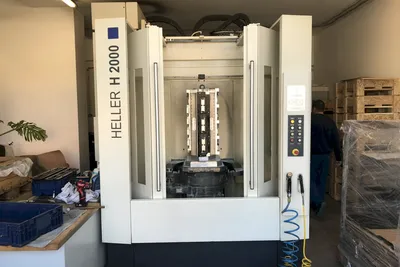
The H 2000 is the larger machine: 630 mm of travel in X, Y and Z, a 500 x 500 mm pallet (400 x 500 mm optional) and a standard table load of 550 kg. The MCP H 400 is listed with a 400 x 400 mm pallet and 500 kg (1,102 lb). Both use the HSK-A63 interface.
More from Gebr. Heller
Other Horizontal Machining Centers (HMC)
Tajmac-ZPS MCH800i
Starrag Heckert HEC 1250
Anger Machining SP2-D

DN Solutions HC 400 II
Vision Wide VHT-1000