Industrial CNC Machine Directory

EMAG VL 4

$250,000 - $320,000 Updated 2026-03-15
EMAG VL 4 CNC Lathes
01

Key Specifications

X Travel

170 mm (6.7 in)

Z Travel

300 mm (11.8 in)

Max Spindle

5,400 RPM

Spindle Power

18.1 kW (24.3 hp)

Max Workpiece ⌀

200 mm (7.87 in)

max workpiece length

150 mm (5.9 in)

02

Overview

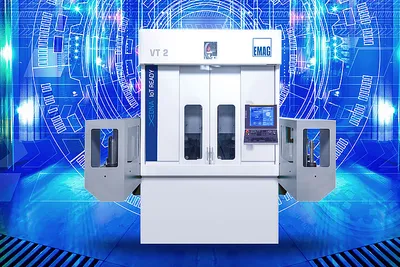
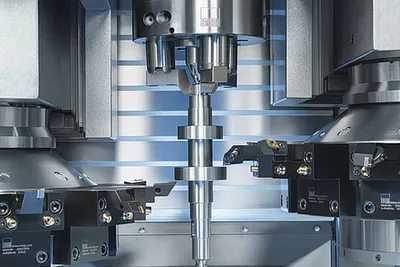
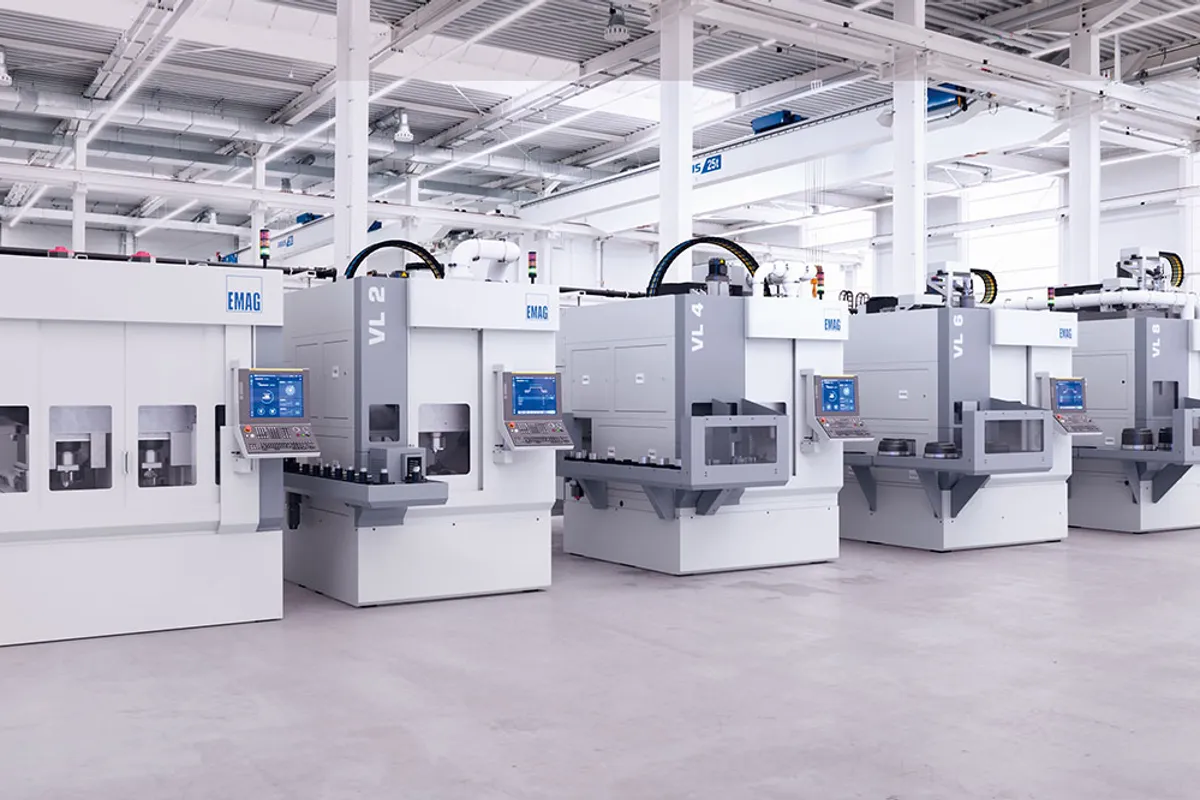
The EMAG VL 4 is a vertical pick-up turning machine designed for high-volume production of chuck-type parts up to 200 mm (7.87 in) diameter. EMAG pioneered the inverted vertical spindle concept where the spindle picks up the workpiece from a conveyor, machines it, and places the finished part back — eliminating the need for a separate gantry loader or robot. This integrated automation makes the VL 4 one of the most productive turning platforms for high-volume automotive and industrial component production.

The VL 4 features a main spindle with 18.1 kW (24.3 hp) continuous power and speeds up to 5,400 RPM. The vertical orientation means gravity assists chip evacuation, and the inverted spindle design ensures chips fall away from the workpiece and machine guideways. This results in better surface finish, longer tool life, and reduced maintenance compared to horizontal lathes in the same production environment. The machine accommodates workpieces up to 200 mm diameter and 150 mm (5.9 in) length.

The turret carries 12 tool stations with VDI 40 toolholders, supporting both turning and optional driven tools for light milling and drilling operations. The machine base is a MINERALIT polymer concrete casting that provides vibration damping 6-8 times better than cast iron, resulting in superior surface finish and tool life. X and Z axis travels of 170 mm (6.7 in) and 300 mm (11.8 in) respectively are optimized for chuck-type part geometries.

The VL 4 runs on Fanuc 31i control with EMAG's production-oriented operator interface. The integrated workpiece handling system uses a conveyor belt and pick-up automation that loads and unloads parts with a cycle-to-cycle time of approximately 6-8 seconds. This means no idle time between parts — the machine is always cutting. Pricing for the VL 4 starts around $250,000 to $320,000, which is higher than a comparable horizontal CNC lathe, but the integrated automation eliminates the $50,000-$100,000 cost of a separate robot or gantry loader. For shops running 100,000+ parts per year, the VL 4's chip-to-chip efficiency delivers a significantly lower cost per part than any manually-loaded horizontal lathe.

03

Full Specifications

Parameter Value
Max Workpiece Diameter 200 mm (7.87 in)
Max Workpiece Length 150 mm (5.9 in)
Max Spindle Speed 5,400 RPM
Spindle Motor Power 18.1 kW (24.3 hp)
Spindle Torque 245 Nm (181 ft-lb)
X-Axis Travel 170 mm (6.7 in)
Z-Axis Travel 300 mm (11.8 in)
Turret Stations 12 (VDI 40)
Chuck Size 210 mm (8.3 in)
Rapid Traverse X 30 m/min (1,181 ipm)
Rapid Traverse Z 30 m/min (1,181 ipm)
Machine Base MINERALIT polymer concrete
Workpiece Handling Integrated pick-up automation with conveyor
CNC Control Fanuc 31i
Machine Weight 5,500 kg (12,125 lb)
Workpiece Dia Max mmin
Workpiece Length Max mmin
Chuck Dia Max mmin
Swing Diameter mmin
X Axis Travel mmin
Y Axis Travel mmin
Z Axis Travel mmin
Main Spindle Power Rating At 40 100 Duty Cycle kWhp
Main Spindle Torque At 40 100 Duty Cycle Nmft-lb
Main Spindle Speed Max rpm

Specifications sourced from emag.com — verified 2026-03-28

04

Strengths & Limitations

Strengths

  • Integrated pick-up automation eliminates separate robot or gantry loader costs, providing fully automated loading in a single machine footprint
  • Vertical inverted spindle design lets gravity clear chips from the cutting zone, reducing chip recutting and improving surface finish by 20-30% vs horizontal lathes
  • MINERALIT polymer concrete base provides 6-8x better vibration damping than cast iron, extending tool life and improving dimensional consistency across production lots
  • 6-8 second load-to-load time means near-zero idle time between parts, maximizing spindle utilization for high-volume production
  • Compact footprint of approximately 2.3 x 2.4 m allows high machine density for multi-machine production cells
  • EMAG's modular platform allows easy integration into production lines with conveyors connecting multiple VL machines for multi-operation processing

Limitations

  • 200 mm maximum workpiece diameter limits the VL 4 to smaller chuck-type parts; larger components require the VL 6 or VL 8
  • Vertical pick-up concept requires parts to be presented in a consistent orientation on the conveyor, which may require custom fixturing for irregular geometries
  • $250K+ price is harder to justify for low-volume or mixed-production shops that cannot maintain high utilization rates
  • Not suitable for shaft-type parts — the VL platform is purpose-built for disc, ring, and short chuck-type workpieces only
05

Best For

Automotive tier 1 and tier 2 suppliers producing brake rotors, gear blanks, bearing races, and hub assemblies at volumes exceeding 100,000 parts per year Bearing manufacturers running high-volume production of inner and outer races requiring consistent concentricity and surface finish Transmission component producers machining synchronizer rings, clutch plates, and planetary gear carriers Shops building multi-machine production lines where EMAG VL machines connect via conveyors for sequential operations (soft turn, hard turn, grinding) Precision manufacturers needing the surface finish and dimensional consistency advantages of polymer concrete machine construction
06

Frequently Asked Questions

01 How does the VL 4 compare to the EMAG VL 2?

The VL 2 handles workpieces up to 100 mm diameter, while the VL 4 extends to 200 mm. The VL 4 also has a more powerful spindle (18.1 kW vs 13.5 kW) and a larger turret. Both share the same pick-up automation concept and MINERALIT base construction. For parts under 100 mm, the VL 2 is more cost-effective. For parts in the 100-200 mm range, the VL 4 is the right choice.

02 Can the VL 4 do hard turning?

Yes. The VL 4 is frequently used for hard turning of case-hardened parts up to 62 HRC. The MINERALIT base's superior vibration damping and the vertical spindle's chip evacuation are both advantageous for hard turning, where surface finish quality is critical. Many automotive bearing and gear producers use VL machines for combined soft and hard turning operations in sequential production line configurations.

03 What is the typical cycle time on the VL 4?

Cycle times depend on part complexity and material, but typical automotive components like brake rotor hubs or bearing races run in 30-90 seconds machining time, plus 6-8 seconds for the automated load/unload cycle. A well-optimized VL 4 producing simple bearing races can output 60-80 parts per hour. The integrated automation means the machine achieves 90%+ spindle utilization in production.

04 What workholding does the VL 4 use?

The VL 4 uses a standard hydraulic chuck, typically 210 mm 3-jaw. Custom collet chucks, diaphragm chucks, and expanding mandrels are available for specific part geometries. The pick-up spindle grips the workpiece from the conveyor automation, so workholding must allow reliable automated clamping without operator intervention. EMAG works with customers to design custom workholding solutions for non-standard parts.

05 Can VL 4 machines be linked in a production line?

Yes, this is one of the VL platform's core strengths. Multiple VL machines connect via conveyor systems for sequential multi-operation processing. A typical automotive line might include a VL 4 for soft turning operation 1, a second VL 4 for operation 2, and a VLC grinding machine for finish grinding. EMAG's TrackMotion linear transport system provides fast, reliable part transfer between machines with minimal floor space.

06 What is the footprint advantage of the VL 4?

The VL 4 occupies approximately 2.3 x 2.4 m (90 x 94 in) of floor space including the integrated automation. A comparable horizontal lathe plus robot cell would require 3.5 x 3.0 m or more. In a 4-machine production line, the VL configuration saves approximately 30-40% floor space compared to horizontal lathes with external automation. This density is a significant advantage in facilities where floor space costs $200-$500 per square meter annually.

07

Videos

EMAG VL 4

EMAG VL 4

mullermachines

VL 4 Vertical Turning Machine - EMAG Videos

VL 4 Vertical Turning Machine - EMAG Videos

EMAGLLC

VL 4 lathe with PICEA clamping system

VL 4 lathe with PICEA clamping system

EMAGLLC

EMAG VLF 4 Vertical Lathe

EMAG VLF 4 Vertical Lathe

Surplex

VL 6 – Vertical Lathe Turning Machine for Heavy Workpieces –  EMAG

VL 6 – Vertical Lathe Turning Machine for Heavy Workpieces – EMAG

EMAGLLC

08

Community Discussions

09

Related Machines