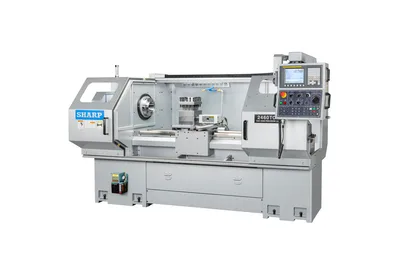
DN Solutions LYNX 2600

Image: dn-solutions.com, DN Solutions
Key Specifications
X Travel
Z Travel
Max Spindle
Rapid Traverse
Spindle Power
Max Turn Length
How much does the DN Solutions LYNX 2600 cost?
Estimated price range
Our best estimate for a cnc lathes / turning center in this class — not a quote from DN Solutions. Configuration moves it a long way.
Overview
The DN Solutions LYNX 2600 is the plain two-axis lathe of its group: a 10 in chuck, a 460 mm (18 in) maximum turning diameter, a 658 mm (26 in) turning length and a 10-station turret. The spindle runs to 3,500 rpm with 18.5 kW (25 hp) and 403 N·m (297 ft-lb).
Leaving out driven tools buys turning capacity. The LYNX 2600 M, which adds 6,000 rpm rotary tools and a 12-station turret to the same spindle and the same travels, is limited to 380 mm (15 in) in diameter and 610 mm (24 in) in length. So for work that is purely turned, this is the variant that swings the largest part, and it does so at 4,750 kg (10,472 lb), the lightest weight in the LYNX 2600 group.
The torque figure is what separates this machine from the smaller Lynx lathes. The LYNX 2100 B, with an 8 in chuck, lists 169 N·m (125 ft-lb) and 15 kW (20 hp) and turns 350 mm (14 in) by 330 mm (13 in). With 403 N·m (297 ft-lb) available, deep roughing passes on diameters near the top of the envelope are realistic, where a smaller spindle would stall or need lighter cuts. The other side of that rating is the 3,500 rpm limit: finishing small diameters at proper surface speed is not what this spindle is geared for.
Travels are 255 mm (10 in) in X and 680 mm (27 in) in Z, both moving at 30 m/min (1,181 ipm) in rapid. Ten stations is fewer than the 12 on the driven-tool models, so long tool lists with duplicate inserts need planning. DN gives the machine as 3,290 × 1,778 × 1,790 mm (130 × 70 × 70 in) in length, width and height. Series features listed by DN are a servo-driven turret, full slideway cover, grease lubrication, a rear-side dual-purpose chip conveyor and the EOP (Easy Operation Package).
Full Specifications
| Parameter | Value |
|---|---|
| Chuck Size | 10 in |
| Max Turning Diameter | 460 mm (18 in) |
| Max Turning Length | 658 mm (26 in) |
| Rapid Traverse Rate | 30 m/min (1,181 ipm) |
| X-Axis Travel | 255 mm (10 in) |
| Z-Axis Travel | 680 mm (27 in) |
| Max Spindle Speed | 3,500 rpm |
| Spindle Motor Power | 18.5 kW (25 hp) |
| Spindle Torque | 403 N·m (297 ft-lb) |
| Turret Stations | 10 |
| Floor Space Required | 3,290 × 1,778 × 1,790 mm (130 × 70 × 70 in) |
| Machine Weight | 4,750 kg (10,472 lb) |
Specifications sourced from dn-solutions.com — verified 2026-10-02
Strengths & Limitations
Strengths
- Largest turning envelope of the LYNX 2600 group: 460 mm (18 in) diameter by 658 mm (26 in) length
- 403 N·m (297 ft-lb) at the spindle from an 18.5 kW (25 hp) motor
- Lightest of the group at 4,750 kg (10,472 lb), with a 3,290 mm (130 in) by 1,778 mm (70 in) plan size
- 680 mm (27 in) of Z travel and 255 mm (10 in) of X travel at 30 m/min (1,181 ipm) rapid
- DN lists the EOP (Easy Operation Package) and a servo-driven turret among the series features
Limitations
- 10 turret stations, where the LYNX 2600 M has 12
- No rotary tool or Y-axis row in the table: holes off the centreline and milled features go to another machine
- 3,500 rpm maximum spindle speed restricts surface speed on small diameters
- The table lists no tailstock or bar capacity figure, so both have to be asked for
Best For
Frequently Asked Questions
01
460 mm (18 in) in diameter and 658 mm (26 in) in length, with a 10 in chuck. X travel is 255 mm (10 in) and Z travel is 680 mm (27 in). These are the largest turning figures in the LYNX 2600 group; the LYNX 2600 M, LYNX 2600 Y and LYNX 2600SY each list 380 mm (15 in) and 610 mm (24 in).
02
The table lists 10 stations. The LYNX 2600 M and LYNX 2600 Y have 12 stations and rotary tools at 6,000 rpm. With 10 fixed-tool stations, check that the roughing, finishing, grooving, threading and boring tools for the longest job all fit without a tool change by hand.
03
Not according to its table, which has no rotary tool speed and no Y travel. The LYNX 2600 M is the sibling with rotary tools at 6,000 rpm on the same 18.5 kW (25 hp) spindle, and the LYNX 2600 Y adds 105 mm (4 in) of Y travel. Both give up turning envelope compared with the 460 mm (18 in) of this model.
04
It is a class larger. The LYNX 2100 B has an 8 in chuck, 4,500 rpm, 15 kW (20 hp), 169 N·m (125 ft-lb), a 350 mm (14 in) by 330 mm (13 in) envelope and weighs 3,100 kg (6,834 lb). The LYNX 2600 has a 10 in chuck, 3,500 rpm, 18.5 kW (25 hp), 403 N·m (297 ft-lb), a 460 mm (18 in) by 658 mm (26 in) envelope and weighs 4,750 kg (10,472 lb).
05
DN lists 3,290 × 1,778 × 1,790 mm (130 × 70 × 70 in) as length, width and height, and 4,750 kg (10,472 lb). A rear-side chip conveyor is listed for the series, so allow for it behind the machine when laying out the cell.
Videos

MTDCNC

Ellison Technologies

Duroc Machine Tool Group
Community Discussions
Comparison and buying advice
Links to community discussions. Summaries are editorial — visit the original thread for full context.
Comparisons
More from DN Solutions
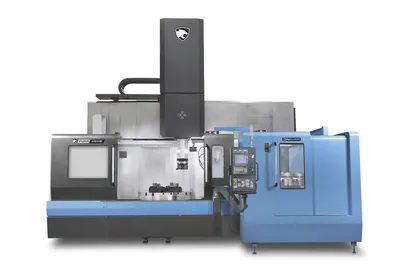
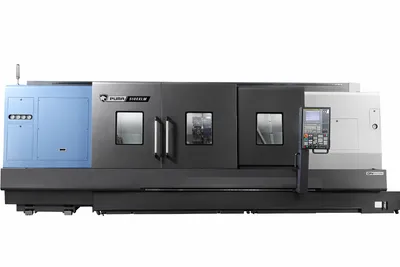
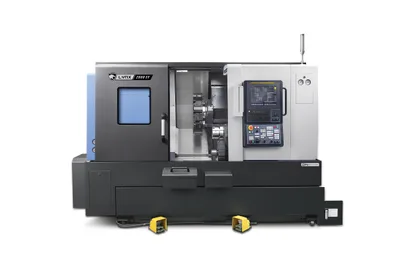
Other CNC Lathes / Turning Centers
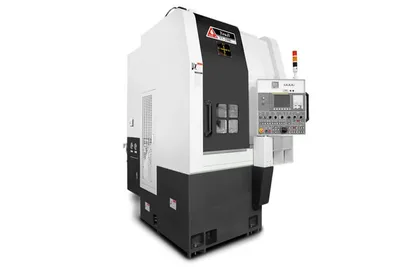
You Ji YV250
Huron DX 200-5B nvu
Hyundai WIA L300C/LC
Colchester Multiturn 6000
Citizen Miyano ABX-51SYY2