DMG Mori SPRINT 42 linear
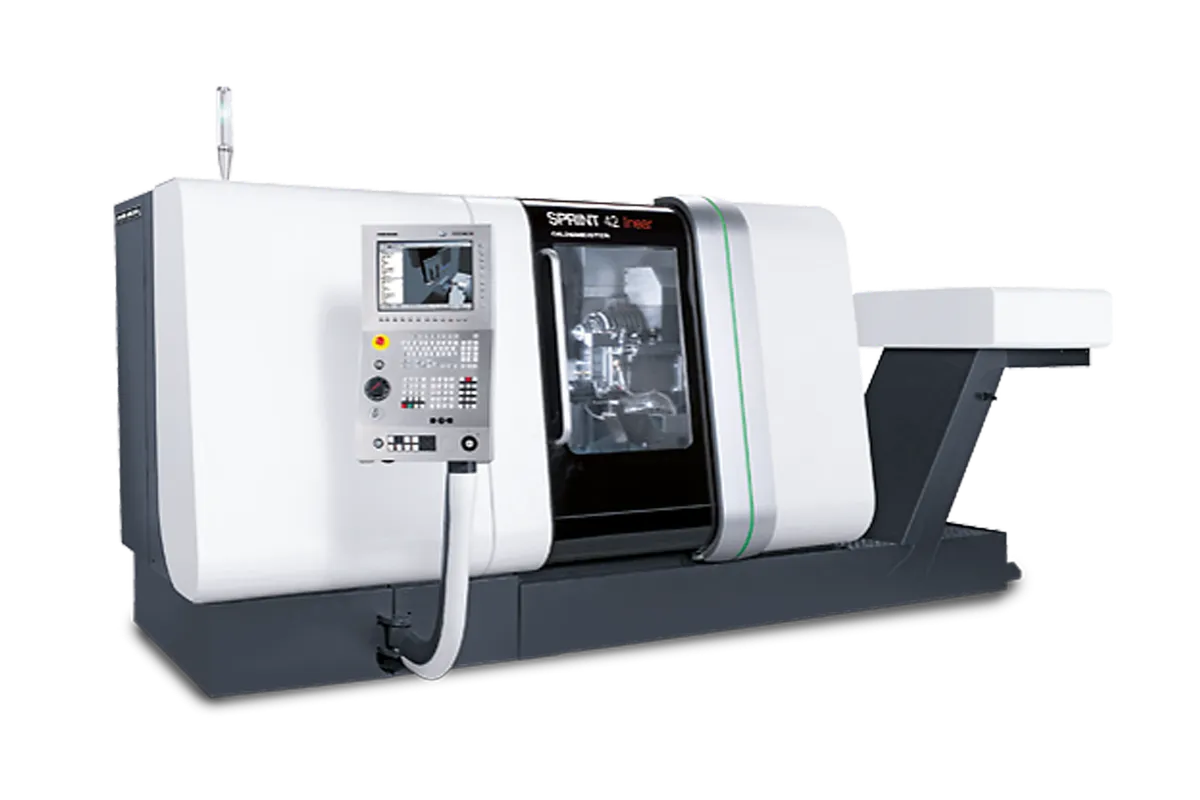
Image: dmgmori.com, DMG Mori
Key Specifications
X Travel
Y Travel
Z Travel
Max Spindle
Tool Capacity
Spindle Power
How much does the DMG Mori SPRINT 42 linear cost?
Estimated price range
Our best estimate for a swiss-type lathe in this class — not a quote from DMG Mori. Configuration moves it a long way.
Overview
The DMG MORI SPRINT 42 linear is an automatic lathe with 6 linear axes and 2 C-axes for 42 mm (1.7 in) bar. It has a main and a counter spindle, both at 6,500 rpm, and a total of 26 tool stations. Maximum workpiece length is 320 mm (12.6 in).
The two spindles are close in strength. The main spindle delivers 27.7 ft lb and 7.4 hp; the counter spindle 19.6 ft lb and 5 hp. The counter spindle has about 29% less torque than the main spindle, a modest gap, so back-working is not restricted to light finishing and a part can be divided more evenly between its two ends.
Driven tooling takes up a large share of the positions. Of the 26 tool stations, 8 are driven as standard and up to 11 driven tools are possible, 3 of them at driven frontal stations. The driven tool spindles are rated 5,000 rpm, 2.2 ft lb and 2.5 hp, enough for cross holes, keyways and flats on 42 mm stock.
The linear in the name is the X1 drive: a linear drive with 1 g of acceleration moves that slide. X1 makes the short approach-and-retract strokes of turning work, where acceleration counts for more than rapid speed.
A FANUC 310i with 2 control channels runs the machine from a SLIMline panel with a 15" screen, and up to 2 tools can work simultaneously. In practice that is one operation on each spindle at a time, which keeps programming and cycle balancing simple. Tool monitoring with a graphical tool load display is optional. Listed travels are 50 mm (2 in) in X, 350 mm (13.8 in) in Y and 120 mm (4.7 in) in Z.
Full Specifications
| Parameter | Value |
|---|---|
| X-Axis Travel | 50 mm (2 in) |
| Y-Axis Travel | 350 mm (13.8 in) |
| Z-Axis Travel | 120 mm (4.7 in) |
| Max Workpiece Diameter | 42 mm (1.7 in) |
| Max Workpiece Length | 320 mm (12.6 in) |
| Max Bar Capacity | 42 mm (1.7 in) |
| CNC Control | FANUC 310i, SLIMline with 15" screen; 2 control channels |
| Axes | 6 linear axes and 2 C-axes |
| Max Spindle Speed | 6,500 rpm (main spindle) |
| Spindle Torque | 27.7 ft lb (main spindle) |
| Spindle Motor Power | 7.4 hp (main spindle) |
| Sub Spindle Speed | 6,500 rpm (counter spindle) |
| Sub Spindle Torque | 19.6 ft lb (counter spindle) |
| Sub Spindle Power | 5 hp (counter spindle) |
| Tool Capacity | Total of 26 tool stations |
| Driven Tools | 8 driven tool stations as standard, up to 11 driven tools; 3 driven frontal stations |
| Driven Tool Speed | 5,000 rpm |
| Driven Tool Torque | 2.2 ft lb |
| Driven Tool Power | 2.5 hp |
| Axis Acceleration | 1 g (linear drive in X1) |
Specifications sourced from dmgmori.com — verified 2026-10-02
Strengths & Limitations
Strengths
- Counter spindle with 19.6 ft lb and 5 hp, not far below the main spindle's 27.7 ft lb and 7.4 hp
- 8 driven tool stations as standard and up to 11 driven tools, including 3 driven frontal stations
- Driven tool spindles rated 5,000 rpm, 2.2 ft lb and 2.5 hp
- Linear drive in X1 with 1 g acceleration
- FANUC 310i control on a SLIMline panel with a 15" screen
- Thermo-symmetric machine bed, large ball guide ways and vertical covers with free chip fall
Limitations
- Up to 2 tools working simultaneously on 2 control channels
- Spindle speed is 6,500 rpm on both spindles, a limit for small-diameter work
- The Tool Monitoring System with graphical tool load display is an option
- Bar capacity ends at 42 mm (1.7 in) and workpiece length at 320 mm (12.6 in)
Best For
Frequently Asked Questions
01
A main spindle with 6,500 rpm, 27.7 ft lb and 7.4 hp, and a counter spindle with 6,500 rpm, 19.6 ft lb and 5 hp. Both are integrated spindle motors with direct measuring systems. There are 2 C-axes.
02
8 driven tool stations are standard, and up to 11 driven tools are possible, with 3 driven frontal stations. The total is 26 tool stations. Driven tool spindles are rated 5,000 rpm, 2.2 ft lb and 2.5 hp.
03
To the drive of the X1 axis. DMG MORI lists a linear drive in X1 with 1 g acceleration, which it connects with dynamics and accuracy. No other axis is described as linear-driven in the Highlights for this model.
04
A FANUC 310i on a SLIMline panel with a 15" screen. It has 2 control channels for 6 linear axes and 2 C-axes, and up to 2 tools can work simultaneously. A Tool Monitoring System with graphical tool load display is an option.
05
In the travel table, yes: the SPRINT 42|10 linear lists the same 50 mm (2 in) of X, 350 mm (13.8 in) of Y and 120 mm (4.7 in) of Z. Bar capacity here is 42 mm (1.7 in) and workpiece length 320 mm (12.6 in). The models differ in axes, channels and tooling, so compare those on each page.
Videos

DMG MORI Japan

Automatics & Machinery

ima gmbh
Community Discussions
Pricing and buying discussion
Links to community discussions. Summaries are editorial — visit the original thread for full context.
More from DMG Mori
Other Swiss-Type Lathes
Tsugami E0165
Nexturn SA51XII
Tsugami P053
Hanwha XD20H
Star Micronics SW-20