DMG Mori NZ DUE
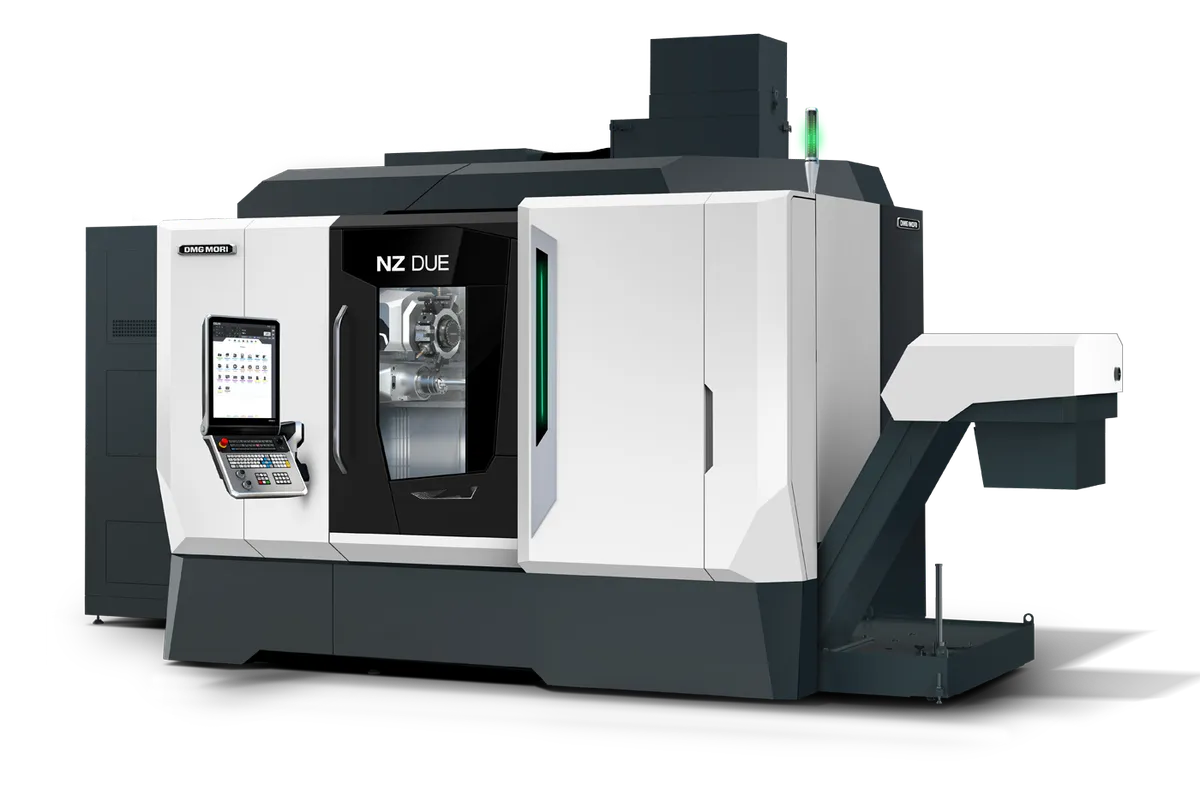
Image: dmgmori.com, DMG Mori
Key Specifications
X Travel
Y Travel
Z Travel
Max Spindle
max workpiece length
max bar capacity
How much does the DMG Mori NZ DUE cost?
Estimated price range
Our best estimate for a cnc lathes / turning center in this class — not a quote from DMG Mori. Configuration moves it a long way.
Overview
The DMG MORI NZ DUE is a production turning center for bar and shaft parts, with a main and a counter spindle, 72 mm (2.8 in) of bar capacity and a maximum workpiece length of 1,290 mm (50.8 in). Travels are 210 mm (8.3 in) in X, 80 mm (3.1 in) in Y and 1,290 mm (50.8 in) in Z.
Start with the spindle speed, because DMG MORI quotes two figures. Both spindles are rated at 174 Nm at 100% DC. The speed is given as up to 7,000 rpm with 5,000 rpm as standard, so 7,000 rpm is the higher version, and a quoted machine should be checked for which one it carries. The spindles come with a 36 month warranty and unlimited spindle hours.
Length is what separates this machine from the NZ DUE Formula, which has the same 210 mm (8.3 in) X and 80 mm (3.1 in) Y travels on 740 mm (29.1 in) of Z. The longer Z of the NZ DUE makes room for shafts and for the TWIN spindle (TS), which DMG MORI calls ideal on the long bed but also possible on the short bed version.
The TWIN spindle creates two independent work areas for 6-sided complete machining. It turns at up to 4,000 rpm and 60 Nm at 100% DC, works as a rotating guide bush at up to 5,000 rpm for SWISSTYPE machining of long slender parts, and can serve as a steady rest.
Driven tools run from a 12,000 rpm built-in motor turret with up to 24 Nm / 16 kW. That is a fast drive with little torque, suited to small end mills and drills. Tooling is 12 stations for VDI 30 and BMT 40, or 16 stations for VDI 25 and BMT 45.
Full Specifications
| Parameter | Value |
|---|---|
| X-Axis Travel | 210 mm (8.3 in) |
| Y-Axis Travel | 80 mm (3.1 in) |
| Z-Axis Travel | 1,290 mm (50.8 in) |
| Max Workpiece Length | 1,290 mm (50.8 in) |
| Max Bar Capacity | 72 mm (2.8 in) |
| B Axis Swivel | -10° to +100° (B-axis possible) |
| Max Spindle Speed | Up to 7,000 rpm (5,000 rpm as standard), main and counter spindle |
| Spindle Torque | 174 Nm (100 % DC), main and counter spindle |
| Driven Tool Speed | 12,000 rpm (built-in motor turret) |
| Driven Tool Torque | Up to 24 Nm |
| Driven Tool Power | Up to 16 kW |
| Turret Stations | 12 stations for VDI 30 and BMT 40 or 16 stations for VDI 25 and BMT 45 |
| Twin Spindle | Turning function up to 4,000 rpm and 60 Nm (100 % DC); rotating guide bush up to 5,000 rpm |
Specifications sourced from dmgmori.com — verified 2026-10-02
Strengths & Limitations
Strengths
- Main and counter spindle both rated at 174 Nm at 100% DC, with up to 7,000 rpm
- 1,290 mm (50.8 in) of Z travel and workpiece length, against 740 mm (29.1 in) of Z on the NZ DUE Formula
- TWIN spindle (TS) with a turning function up to 4,000 rpm and 60 Nm, a rotating guide bush up to 5,000 rpm and a steady rest function
- 12,000 rpm built-in motor turret with up to 24 Nm / 16 kW
- A B-axis with a -10° to +100° swivel range is possible, allowing standard tools in place of special angle tools
- 36 month spindle warranty with unlimited spindle hours
Limitations
- 5,000 rpm is the standard spindle speed; 7,000 rpm is the upper version
- Driven tool torque is up to 24 Nm, which restricts milling to small cutters and drills
- Y travel is 80 mm (3.1 in), against 110 mm (4.3 in) on the NZX 1500 and NZX 2000
- Bar capacity is 72 mm (2.8 in); DMG MORI's table gives no maximum chucking diameter for this model
Best For
Frequently Asked Questions
01
In the published travels, Z. The NZ DUE has 1,290 mm (50.8 in) of Z travel and the NZ DUE Formula has 740 mm (29.1 in). X travel of 210 mm (8.3 in) and Y travel of 80 mm (3.1 in) are the same on both.
02
DMG MORI gives the main and counter spindle as up to 7,000 rpm, with 5,000 rpm as standard, and 174 Nm at 100% DC. Check which speed version is quoted, because the 7,000 rpm figure is not the standard one.
03
It gives two independent work areas for 6-sided complete machining. It has a turning function with up to 4,000 rpm and 60 Nm at 100% DC, a SWISSTYPE function as a rotating guide bush at up to 5,000 rpm, and a steady rest function. DMG MORI calls it ideal on the long bed but also possible on the short bed version.
04
Either 12 stations for VDI 30 and BMT 40, or 16 stations for VDI 25 and BMT 45. The driven tools run from a 12,000 rpm built-in motor turret with up to 24 Nm / 16 kW.
05
DMG MORI lists a B-axis as possible, with a swivel range of -10° to +100°. Its stated purpose is to let standard tools replace special angle tools and to make 5-axis simultaneous operation possible. Confirm which turret carries it on the machine quoted.
More from DMG Mori
Other CNC Lathes / Turning Centers
HNK NT-100/160
Haas ST-10LY
Sharp STB-55
Goodway GS-4000