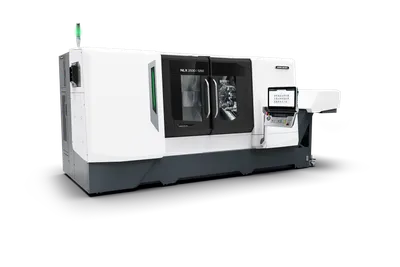
DMG Mori CTX 450 4A
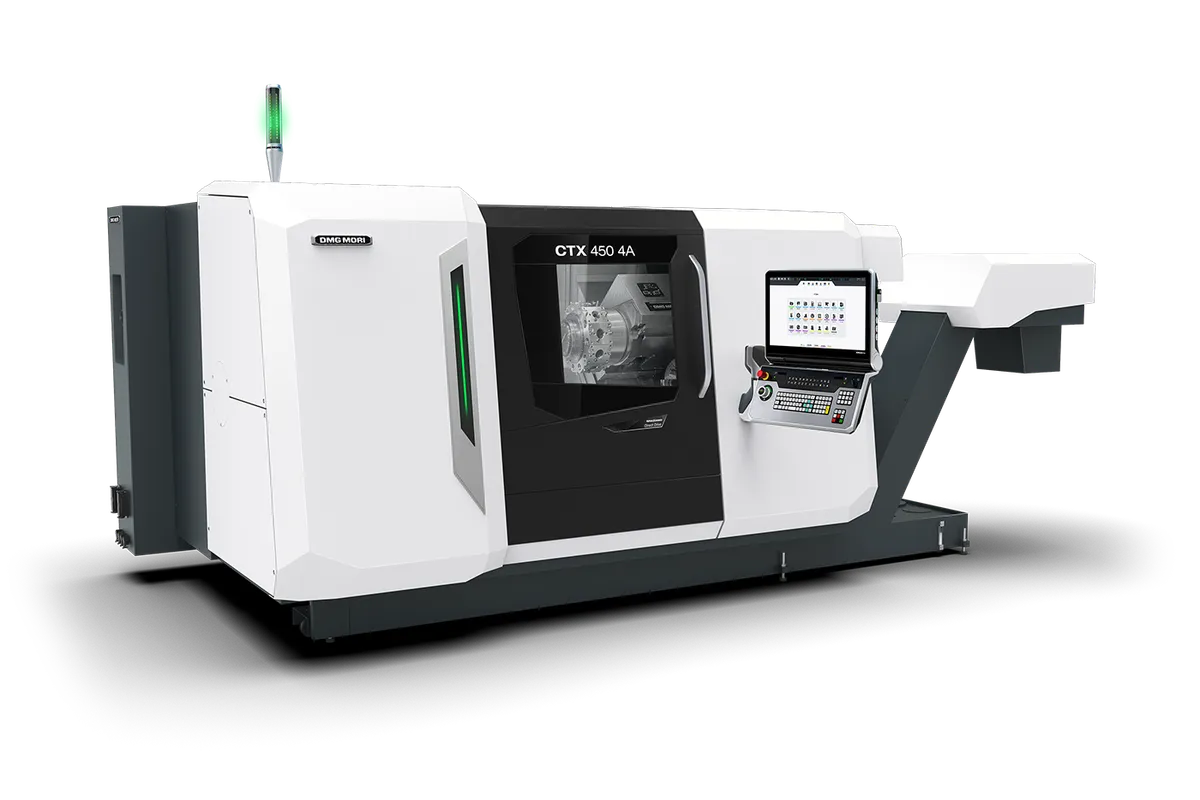
Image: dmgmori.com, DMG Mori
Key Specifications
X Travel
Y Travel
Z Travel
Max Spindle
Tool Capacity
Max Workpiece ⌀
How much does the DMG Mori CTX 450 4A cost?
Price estimate
We do not have a price for the DMG Mori CTX 450 4A that we can stand behind, so we show no number. Configuration, options and installation move the final price a long way: a quote is the reliable figure.
Overview
The DMG MORI CTX 450 4A is a universal turning machine with two tool carriers, two spindles and up to 36 tool positions. It takes workpieces up to 430 mm (16.9 in) in diameter and bar up to 102 mm (4 in), with travels of 280 mm (11 in) in X, 130 mm (5.1 in) in Y and 760 mm (29.9 in) in Z.
Both turrets can work on both spindles, one at a time or simultaneously, so two tools can cut the same part or each turret can serve its own spindle. The upper turret carries the 130 mm Y-axis, a stroke of ±65 mm. As a VDI 40 turret it has 12/16 tool stations with driven tools at up to 12,000 rpm or 38 Nm, and an optional VDI 30 version has 20 tool stations with the same speed and torque. The lower turret is a VDI 40 with 12 tool stations, 12,000 rpm and max. 38 Nm. Its optional VDI 30 version has 16 tool stations but only max. 11 Nm. The 36-position total therefore means both VDI 30 turrets, and on the lower one it costs most of the driven-tool torque.
The left spindle is an ISM 80 with 4,500 rpm and 280 Nm, or optionally an ISM 102 with 3,500 rpm and 620 Nm. The right spindle is an ISM 65 with 5,500 rpm and max. 171 Nm, or optionally an ISM 80 with 4,500 rpm and 280 Nm. Bar machining is listed up to Ø 102 mm, so check which left spindle that figure assumes.
DMG MORI states positioning accuracy within 6 µm and 12 arcseconds. Direct scales by Magnescale in X1, X2, Y1 and Z are optional. The integrated unloading device takes workpieces up to Ø 100 x 350 mm and 4 kg, which covers bar parts but not the larger chuck work. The machine does all this on 10.8 m² of floor.
The table gives a maximum workpiece length of 800 mm (31.5 in), while the Highlights describe 6-sided complete machining of workpieces up to Ø 430 x 700 mm; plan two-spindle jobs around the shorter figure. The CTX 450 has 310 mm (12.2 in) of X and 825 mm (32.5 in) of Z and takes 480 mm (18.9 in) in diameter.
Full Specifications
| Parameter | Value |
|---|---|
| X-Axis Travel | 280 mm (11 in) |
| Y-Axis Travel | 130 mm (5.1 in) |
| Z-Axis Travel | 760 mm (29.9 in) |
| Max Workpiece Diameter | 430 mm (16.9 in) |
| Max Workpiece Length | 800 mm (31.5 in) |
| Max Bar Capacity | 102 mm (4 in) |
| Sub Spindle Speed | Right spindle: 5,500 rpm (ISM 65); 4,500 rpm (optional ISM 80) |
| Driven Tool Speed | Up to 12,000 rpm (upper and lower turret) |
| Max Spindle Speed | Left spindle: 4,500 rpm (ISM 80); 3,500 rpm (optional ISM 102) |
| Spindle Torque | Left spindle: 280 Nm (ISM 80); 620 Nm (optional ISM 102) |
| Sub Spindle Torque | Right spindle: max. 171 Nm (ISM 65); 280 Nm (optional ISM 80) |
| Tool Capacity | Up to 36 tool positions on two tool carriers |
| Turret Stations | Upper turret: 12/16 (VDI 40) or optional 20 (VDI 30); lower turret: 12 (VDI 40) or optional 16 (VDI 30) |
| Driven Tool Torque | 38 Nm (upper turret; VDI 40 lower turret); max. 11 Nm (optional VDI 30 lower turret) |
| Positioning Accuracy | Within 6 µm // 12 arcseconds |
| Floor Space | 10.8 m² |
| Unloading Device | Workpieces up to Ø 100 x 350 mm and 4 kg |
Specifications sourced from dmgmori.com — verified 2026-10-02
Strengths & Limitations
Strengths
- Two turrets that can work on both spindles individually or simultaneously
- Up to 36 tool positions with the optional VDI 30 turrets: 20 tool stations above and 16 below
- Driven tools at up to 12,000 rpm or 38 Nm on the VDI 40 upper turret, and 12,000 rpm with max. 38 Nm on the VDI 40 lower turret
- Left spindle ISM 80 with 4,500 rpm and 280 Nm; an ISM 102 with 3,500 rpm and 620 Nm is optional
- 130 mm (5.1 in) Y-axis on the upper turret, a stroke of ±65 mm
- Integrated unloading device for workpieces up to Ø 100 x 350 mm and 4 kg
Limitations
- The optional 16-station VDI 30 lower turret has max. 11 Nm of driven-tool torque, against max. 38 Nm on the VDI 40 lower turret
- Direct scales by Magnescale in X1, X2, Y1 and Z are optional
- The right spindle as an ISM 65 has max. 171 Nm against 280 Nm on the left ISM 80; equal spindles need the optional ISM 80 on the right
- The unloading device stops at Ø 100 x 350 mm and 4 kg, so heavier chuck parts need another way out of the machine
- The Y-axis is listed for the upper turret only
Best For
Frequently Asked Questions
01
Two tool carriers with up to 36 tool positions. The upper turret has 12/16 tool stations as a VDI 40 turret or 20 tool stations as the optional VDI 30 turret. The lower turret has 12 tool stations as a VDI 40 turret or 16 tool stations as the optional VDI 30 turret. Both turrets can work on both spindles, individually or simultaneously.
02
Left spindle: ISM 80 with 4,500 rpm and 280 Nm, optionally ISM 102 with 3,500 rpm and 620 Nm. Right spindle: ISM 65 with 5,500 rpm and max. 171 Nm, optionally ISM 80 with 4,500 rpm and 280 Nm. With the optional ISM 80 on the right, both spindles have the same speed and torque.
03
On the VDI 40 turrets, upper and lower, DMG MORI gives up to 12,000 rpm and 38 Nm. The optional VDI 30 upper turret with 20 tool stations has the same 12,000 rpm or 38 Nm. The optional VDI 30 lower turret with 16 tool stations is rated 12,000 rpm and max. 11 Nm, so heavier milling belongs on the upper turret in that configuration.
04
The table gives a maximum workpiece diameter of 430 mm (16.9 in), a maximum workpiece length of 800 mm (31.5 in) and a bar capacity of 102 mm (4 in). For 6-sided complete machining DMG MORI's Highlights quote workpieces up to Ø 430 x 700 mm. Z travel is 760 mm (29.9 in).
05
The CTX 450 4A has two tool carriers and slightly less travel than the CTX 450: 280 mm (11 in) in X and 760 mm (29.9 in) in Z, against 310 mm (12.2 in) and 825 mm (32.5 in) on the CTX 450. Y travel is 130 mm (5.1 in) on both. The CTX 450 takes workpieces up to 480 mm (18.9 in) in diameter, the CTX 450 4A up to 430 mm (16.9 in).
Videos

DMG MORI

DMG MORI

DMG MORI

DMG MORI
Comparisons
More from DMG Mori
Other CNC Lathes / Turning Centers
DN Solutions PUMA TT 1300 SY
Hwacheon VT-3000
Hardinge GS-200-66L