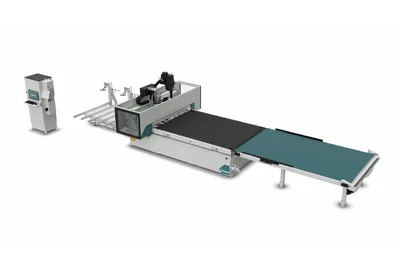
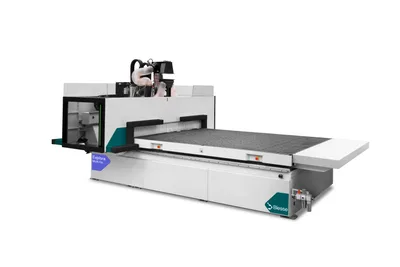
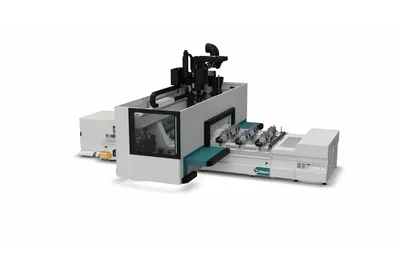
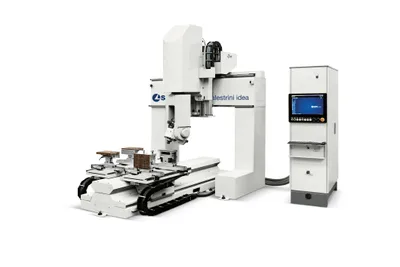
Biesse Materia
This model was not found in Biesse's current lineup when we checked on 2026-10-03 . It may be a superseded or older model; the specifications below are as we last recorded them.
Key Specifications
Accuracy
x axis travel
y axis travel
z axis travel
main spindle speed
main spindle power
How much does the Biesse Materia cost?
Estimated price range
Our best estimate for a cnc router in this class — not a quote from Biesse. Configuration moves it a long way.
Overview
The Biesse Materia is a CNC router for composite materials. The listed figures give X travel of 2,100 to 4,300 mm depending on configuration, Y travel of 1,600 to 2,100 mm and Z travel of 200 to 350 mm, with a high-frequency electrospindle that runs at up to 60,000 rpm. The model is not in Biesse's current lineup under this name, so confirm each figure for the machine you are looking at.
Spindle speed is the row that sets this machine apart. Up to 60,000 rpm with up to 10 kW points to small-diameter tools taking light cuts at high surface speed, which is how carbon and glass laminates are trimmed and drilled without pulling fibres or lifting the edge plies. It is not a spindle for heavy stock removal. The Rover B 7.23, by comparison, is listed at 24,000 RPM and 14.5 kW (19.4 HP).
The compatible materials row lists CFRP, GFRP, Kevlar, aluminum honeycomb, thermoplastic composites and prepreg. Two other rows follow from that list. Dust extraction is described as an integrated CFRP-rated system, which matters because carbon dust is abrasive and conductive and has to be kept away from the operator and the electrics. A tangential oscillating knife is listed as optional, for soft sheet such as uncured prepreg that a rotating tool would fray; do not assume a given machine has one.
Parts are held by multi-zone vacuum hold-down, so a sheet smaller than the bed can be clamped without sealing off the rest. Rapid feed is listed at up to 60 m/min and positioning accuracy at ±0.05 mm. Because every travel is a range, the envelope has to be established per machine. The Z figure in particular, 200 to 350 mm, decides whether formed parts fit at all. The control row names Biesse BiesseWorks.
Full Specifications
| Parameter | Value |
|---|---|
| X Axis Travel | 2,100 – 4,300 mm (configuration dependent) |
| Y Axis Travel | 1,600 – 2,100 mm |
| Z Axis Travel | 200 – 350 mm |
| Main Spindle Speed | Up to 60,000 rpm (high-frequency electrospindle) |
| Main Spindle Power | Up to 10 kW |
| Knife Unit | Tangential oscillating knife (optional) |
| Vacuum Table | Multi-zone vacuum hold-down |
| Rapid Feed Rate | Up to 60 m/min |
| Positioning Accuracy | ±0.05 mm |
| Dust Extraction | Integrated CFRP-rated extraction system |
| CNC Control | Biesse BiesseWorks |
| Compatible Materials | CFRP, GFRP, Kevlar, aluminum honeycomb, thermoplastic composites, prepreg |
Specifications compiled from manufacturer literature and industry references. Not independently verified against a published spec sheet — confirm with the manufacturer or an authorised dealer before making a purchasing decision.
Strengths & Limitations
Strengths
- High-frequency electrospindle listed at up to 60,000 rpm, suited to small-diameter tools in fibre laminates
- An integrated CFRP-rated dust extraction system is listed
- Multi-zone vacuum hold-down clamps sheets smaller than the full table
- Positioning accuracy listed at ±0.05 mm, with rapid feed of up to 60 m/min
- X travel is listed from 2,100 to 4,300 mm and Y from 1,600 to 2,100 mm, depending on configuration
Limitations
- Spindle power is listed at up to 10 kW, against 14.5 kW (19.4 HP) for the Rover B 7.23, so heavy roughing is outside its scope
- The tangential oscillating knife is optional, not part of every machine
- Z travel of 200 to 350 mm limits the height of formed parts and their fixtures
- The listed figures give no tool changer row and no axis count, so both need checking on the machine
Best For
Frequently Asked Questions
01
The compatible materials row lists CFRP, GFRP, Kevlar, aluminum honeycomb, thermoplastic composites and prepreg. The dust extraction row describes an integrated CFRP-rated extraction system, which fits that list: carbon dust is abrasive and conductive and must be captured at the tool.
02
The main spindle is listed as a high-frequency electrospindle running at up to 60,000 rpm, with power of up to 10 kW. That combination suits small cutters and drills in laminates. For comparison, the Rover B 7.23 is listed at 24,000 RPM and 14.5 kW (19.4 HP).
03
Only as an option. The knife unit row lists a tangential oscillating knife as optional, so a particular machine may or may not carry it. Check for the knife unit before planning to cut prepreg or other soft sheet on a used machine.
04
It depends on the configuration. X travel is listed from 2,100 to 4,300 mm, Y travel from 1,600 to 2,100 mm and Z travel from 200 to 350 mm. Ask for the travels of the specific machine, because the largest listed X is roughly double the smallest.
Videos

Biesse

BIESSE PLAST

Текноком Украина

Eyüp Eren